

The infusion consisted of the women's own bone-marrow cells, coated in a sugar so the cells could find bone. Six years later they were breaking bones about once a decade instead of every year or two, which is close to stopping but still not the same thing. What the trial does show is how far the idea of steering a cell through the body has come and that is a part that deserves your attention.
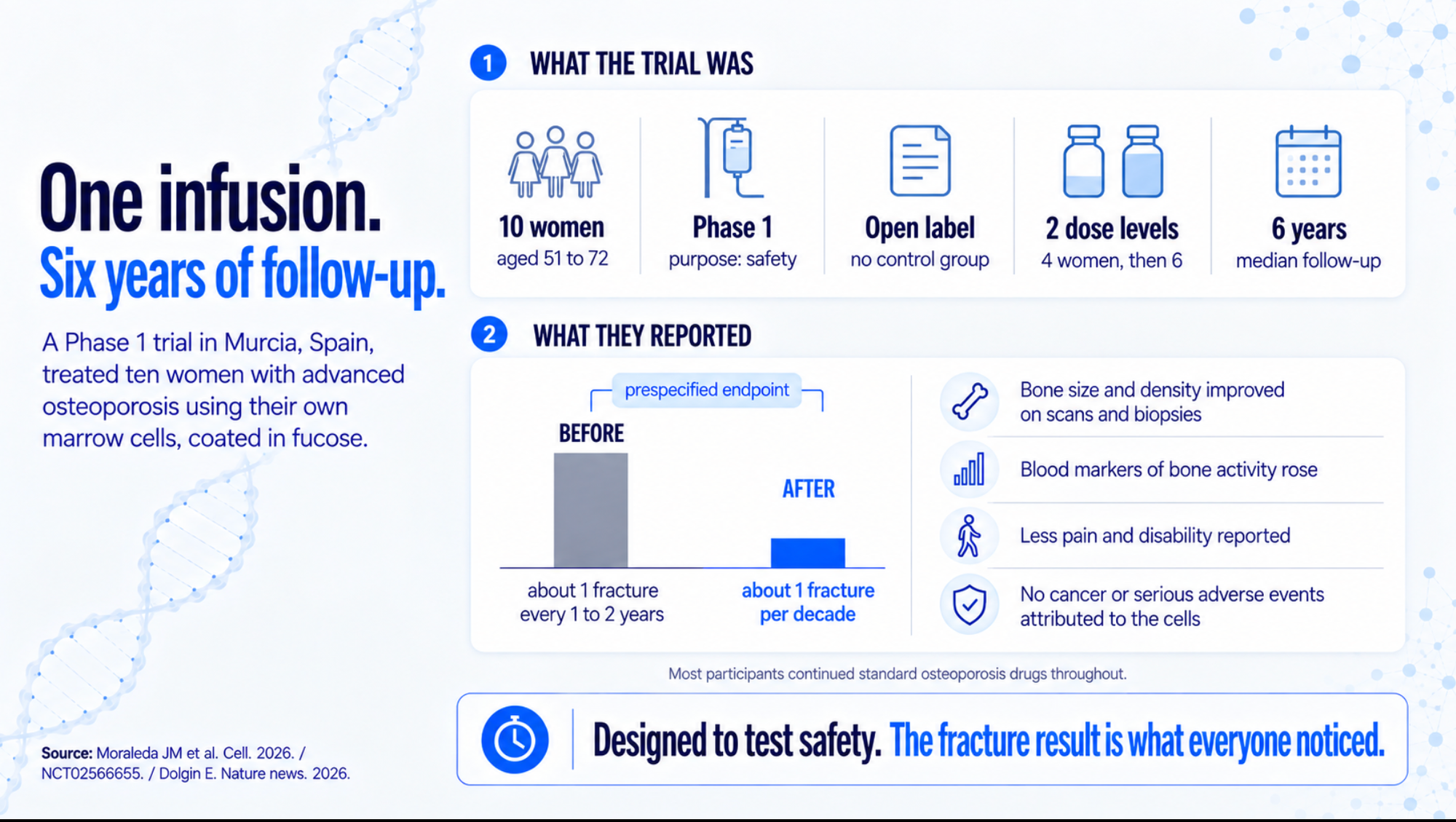
So, what happened? Ten women between 51-72 years old had advanced osteoporosis. Between them they had broken bones dozens of times, in the spine, the hips, the arms, often after little more than a stumble. Before entering a small trial in Murcia, Spain, they were fracturing roughly every 1 to 2 years on average [1].
Then researchers took cells from each woman's own bone marrow, grew them in the lab, changed the “sugar coating” on their surface and infused them back into a vein. They administered only 1 infusion and after a median follow-up of 6 years, low-impact fractures had fallen to a rate closer to once per decade [1]. The trial was published this week in the Cell journal [2].
Stop reading here and you would have a miracle. You would also have made the reading error that a lot of commercial stem-cell marketing depends on.
I think this study matters for a reason that has little to do with the fracture numbers. The cells the team used are not new. Versions of them have been infused into patients since the 1990s, usually with little to show for it, because an infused cell has no way of knowing where it is needed. What this team changed was the surface of the cell, so that it could find bone.
Menopause changes bone long before the first fracture
Menopause is usually discussed through hot flashes, sleep, mood, weight, and sexual health. One of its most consequential changes shows up only on a DXA scan, a low-dose X-ray that measures how dense a bone is, which is why it goes unnoticed for years.
Bone is living tissue, rebuilt continuously throughout adult life by two families of cells working against each other. Osteoclasts dissolve old bone and carry it away. Osteoblasts lay down fresh bone in its place. In a healthy adult the two stay roughly in balance, and the skeleton you have at 40 is the same weight as the one you had at 30 even though almost none of the material is the same. After menopause, the fall in oestrogen, the hormone that had been restraining the demolition crew, speeds up the whole cycle and tips it toward removal. Over years the internal scaffolding of the bone thins out. Nothing hurts. Then a fall that would have left a bruise at 40 breaks a wrist at 65, one of the bones of the spine collapses under ordinary load, or a hip gives way.
The scale is large. Across the 27 EU countries plus Switzerland and the UK, 4.3 million new fragility fractures were recorded in 2019, about 11,700 per day [3]. A fragility fracture is a break caused by force that should not break a bone, such as a fall from standing height. 32 million people over 50 were estimated to have osteoporosis, 25.5 million of them women [3]. A 50-year-old European woman carries a 15% lifetime probability of a hip fracture, and hip fractures are the deadliest of the lot [3].
Medicine already has drugs that work here, and that changes how you should read an experimental cell therapy. One group slows the demolition crew down. It includes the bisphosphonates, usually a weekly tablet, and denosumab, an antibody given as an injection twice a year. A second group pushes the building crew instead. Teriparatide, a form of parathyroid hormone injected daily, and romosozumab, a monthly injection that releases a brake on bone formation, are used in women at very high fracture risk. For selected women around menopause, hormone therapy protects bone as well. So building new bone with a drug is already possible today. The cell therapy proposes something different: deliver living, bone-forming cells to the place where bone is made, instead of sending a molecule that instructs the cells already there.
That sounds simple until you ask where a cell goes after you inject it.
Most infused stem cells never get anywhere near bone
The cells in this trial are mesenchymal stromal cells, or MSCs, cells taken from bone marrow and other tissues that can grow into bone-forming cells and release signals that prompt repair nearby. Regenerative medicine has been fascinated with them for 30 years. They are not embryonic stem cells and they are not the blood-forming stem cells used in leukaemia transplants. They are an adult repair cell that every one of us carries.
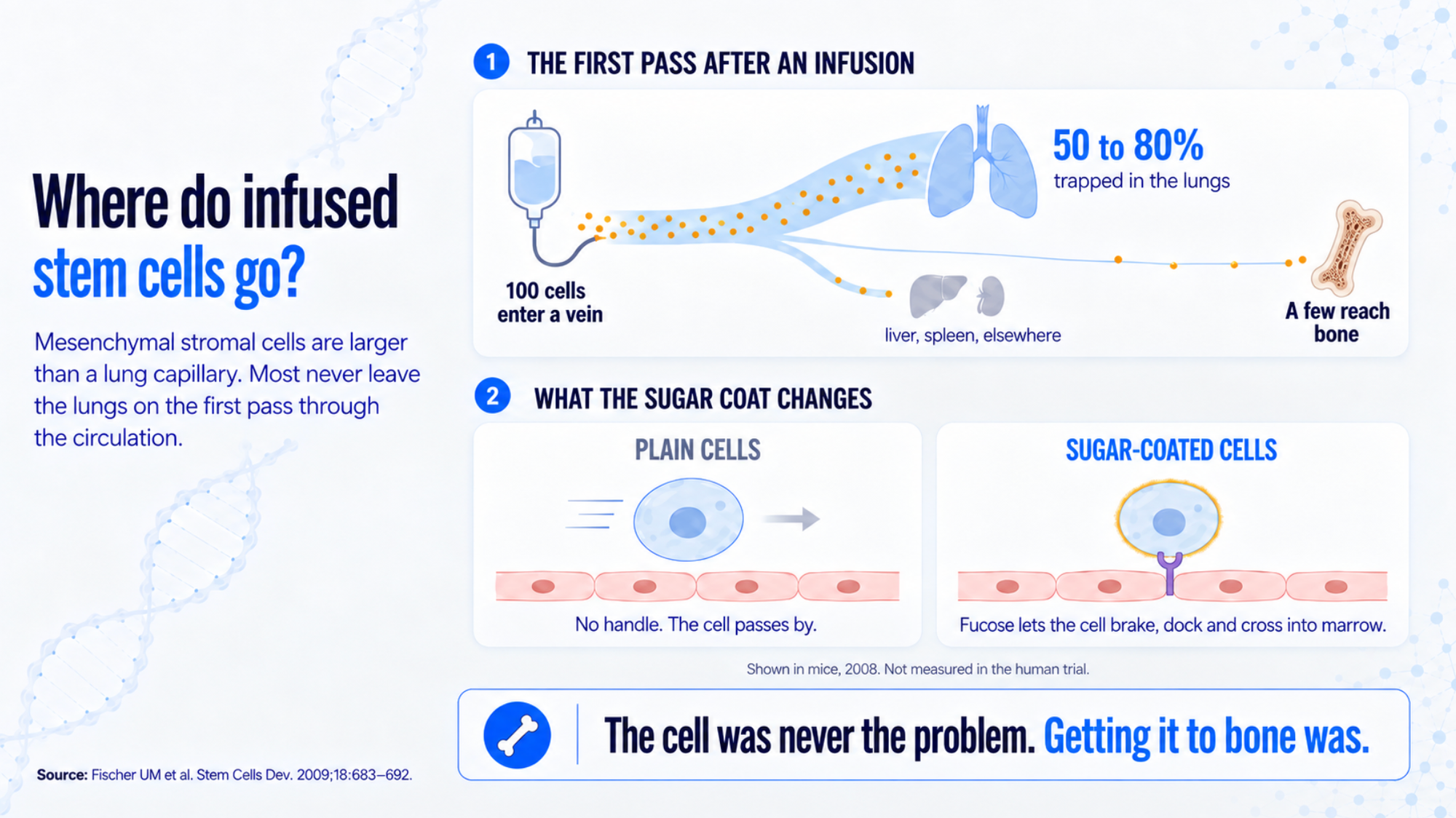
But they have one large practical flaw when you infuse them into a vein. MSCs are 20 to 30 micrometres across, larger than a lung capillary, so on the first pass through the circulation 50 to 80% of them lodge in the lungs [4]. Of the rest, very few find their way into bone marrow on their own. You can have a potentially useful cell circulating and achieve almost nothing, because it never reaches the tissue you want to treat.
Robert Sackstein, a physician-scientist now in Miami, has spent much of his career on this navigation problem. His solution is a sugar.
Cells carry a coat of sugar chains on their surface. In 2008 his group showed that adding a single sugar with the name “fucose” (not to be mistaken with fructose!), to one of those chains on the MSC surface creates a molecular handle, which the researchers named HCELL. The handle grips a matching hook called E-selectin, a sticky protein that the blood vessels inside bone marrow display on their inner walls and most other vessels do not [5]. Picture what has to happen mechanically. A cell racing through the bloodstream has to slow down, then stick to the vessel wall, then squeeze through it into the tissue. The fucose handle provides the braking and docking step. In mice, fucosylated human MSCs found their way into bone marrow and formed bone tissue there, whereas untreated cells largely did not [5].
The cells are not genetically modified, though. The extra sugar is added by an enzyme in a dish, the way a chemist adds one link to a chain and it disappears from the cell surface within about 2 days, so its only job is to get the cell to the right place [1]. And Sackstein's own name for the method is GPS, for glycosyltransferase-programmed stereosubstitution [6]. When the Murcia team announced its first treated patient in 2016, the regional health minister picked up his image and described the method to the press appropriately as “GPS technology for cells” [7].
Twenty years ago we were trying to fix bone where it broke
My early years as an orthopaedic trauma surgeon included some regenerative research on bone healing. Twenty years ago we were already asking how damaged bone could be persuaded to repair itself and almost all of our thinking was “local”, wondering how to stimulate repair at the site of an injury, with scaffolds, growth factors, or cells placed directly into the defect.
We worked with our hands at the fracture site. If a bone would not heal, we opened it, cleaned out the dead tissue, and packed the gap with graft material, sometimes with growth factors, sometimes with marrow drawn from the patient's own pelvis an hour earlier. One bone, one place, reached with a scalpel.
The Murcia trial reaches bone through a drip in the arm. Nobody opened anything. The cells were changed in a laboratory so that the bloodstream would deliver them and the target was the whole skeleton at once. Other tissues put their own sticky proteins on their vessel walls, so in principle the same trick could also be pointed somewhere else entirely.
That is what I find remarkable about this work. Whether the cells actually helped these 10 women is a separate matter and the trial's design makes it hard to settle.
One infusion, 6 years of follow-up
The trial began in 2015 at the Hospital Clínico Universitario Virgen de la Arrixaca in Murcia, led by the haematologist José Moraleda. The registry entry describes the design plainly, as a prospective, single-centre, open-label, non-randomised, unblinded Phase 1 study whose stated purpose was safety [8]. Women aged 50 to 75 with established osteoporosis and at least one low-impact fracture were eligible. The first 4 received 2 million cells per kilogram of body weight, the next 6 received 5 million [8].
The road to 10 patients was not particularly smooth. Of the first 7 women recruited, 2 never received cells. In one, the cells would not multiply in culture. In the other, the cultured cells developed a complex karyotype, a chromosomal abnormality, and were discarded [9]. That is how the safety process should work, and it is also a reminder that growing a person's cells in a lab for weeks is not a trivial step.
What the investigators report after a median of 6 years, as summarised in the Nature news report on the paper [1]:
- Fracture frequency fell sharply, from roughly one every 1 to 2 years before treatment to about one per decade afterwards.
- Scans and bone biopsies showed improvements in bone size and density.
- Blood levels of proteins involved in bone formation rose.
- The women reported less pain and disability.
- No increase in cancer or other serious adverse events was attributed to the cells.
It's relevant to highlight here that fracture reduction was a prespecified secondary endpoint and not just a pattern noticed afterwards [9]. Ajit Varki of UC San Diego, who was not involved, told Nature the trial showed almost 100% efficacy sustained for several years [1].
Ten women cannot show that the cells did it
Let's briefly talk about the efficacy figure first. By Nature's own description the fracture rate fell by roughly 80 to 90% and even that figure assumes the comparison is fair. A before-and-after count in the same 10 women, with no comparison group, cannot produce an efficacy number at all, because it cannot separate the treatment from everything else that happened to those women over 6 years.
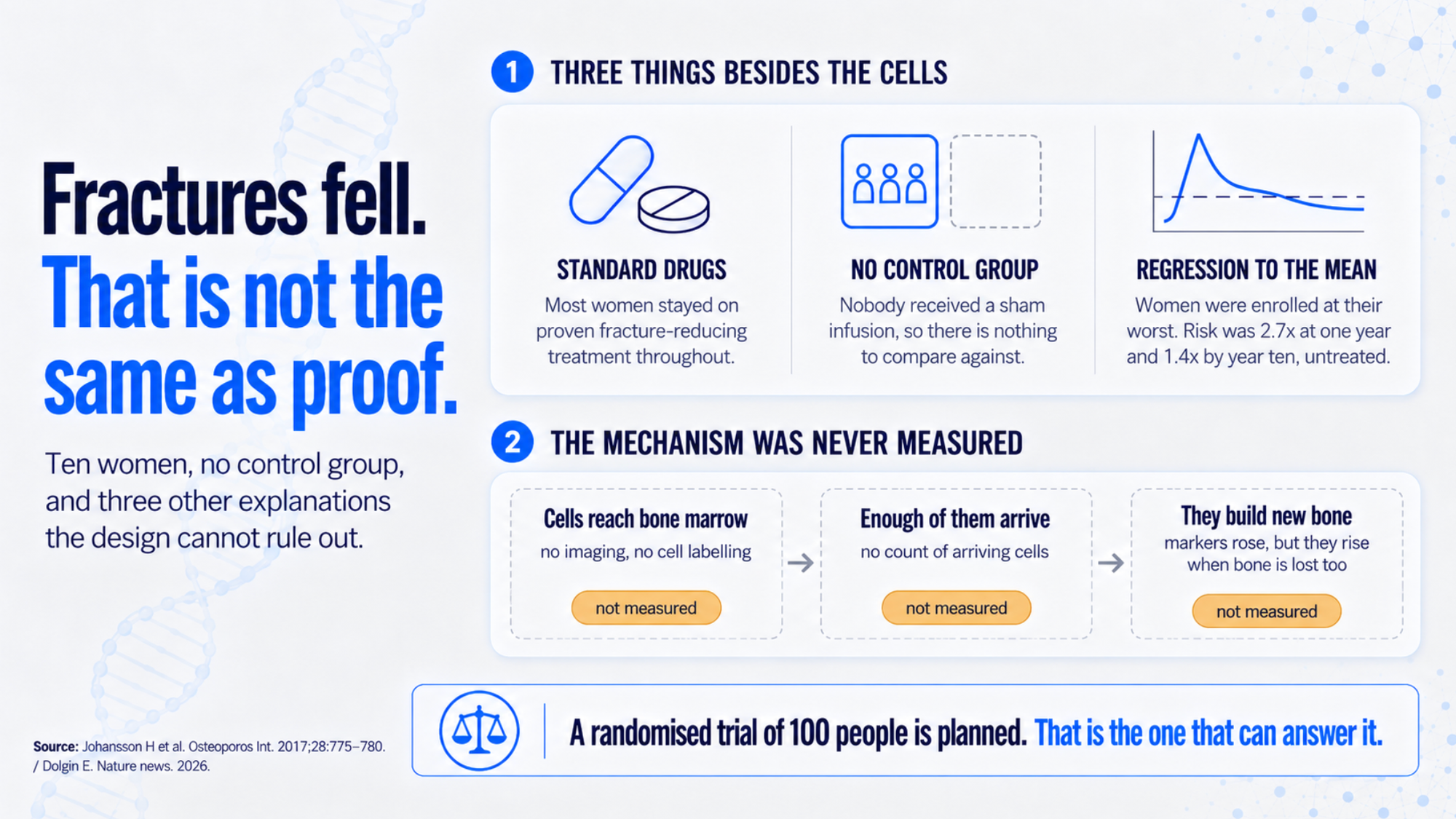
Why? Because 3 things happened to them.
First, most were taking conventional osteoporosis drugs before and during the trial [1]. Those drugs are known to cut fracture risk substantially. Some of the improvement is theirs.
Second, there was no control group [8]. Nobody received a sham infusion, so nobody can say what the fracture rate would have been without the cells.
Third, and this is the point the news coverage skipped, the women were enrolled because they had recently been fracturing. Fracture risk is not constant. In the Reykjavik cohort, the risk of another major osteoporotic fracture was 2.7 times the population rate in the first year after a fracture and had fallen to 1.4 times by year 10, with no treatment involved in that arithmetic [10]. A group selected at its worst moment will look better later on its own. Statisticians call it regression to the mean. Every orthopaedic surgeon has seen it in a clinic.
Those three problems all concern the comparison, meaning what else could explain fewer fractures. A second set concerns the chain of events the treatment assumes. For it to work as described, the sugar coat has to carry the cells into bone marrow, enough of them have to arrive, and once there they have to build new bone. None of those three steps was measured in these women.
Nobody followed the cells after the infusion. No scan, no label, no way of counting how many reached bone, or where else they ended up, or how long they stayed [1]. The steering was demonstrated in mice in 2008 and taken on trust here.
The blood tests come closest to evidence for the third step, and they do not settle it either. Bone cells shed small amounts of protein into the bloodstream while they work, and those levels rose after treatment, which sounds like proof of new bone. Richard Eastell, an osteoporosis researcher at the University of Sheffield, told Nature what the proteins show, which is that the skeleton has sped up [1]. Both crews speed up together. Higher levels can mean more bone being built, more being dissolved, or both at once, and this trial cannot separate them.
The safety result needs the same care. None of the 10 women developed cancer or another serious complication over 6 years and that is genuinely reassuring, because the standing worry with any cell grown in a laboratory and returned to a body is that it turns into a tumour. But 10 is a small number. Suppose a treatment caused a serious problem in 1 patient out of every 5. Run it in 10 women and roughly one time in ten you would still see nothing at all, purely by chance. Put precisely, zero events in 10 people is compatible with a true rate of up to 26% [11]. Small trials cannot rule out uncommon harms, which is one of the things the larger trial is for.
So the sentence this trial supports is a long way from the headline, including mine. 10 women with severe osteoporosis, most of them continuing standard drug treatment, broke far fewer bones in the years after one infusion of sugar-coated cells than in the years before, and the design cannot tell you whether the cells did it. Worth knowing. Not yet reason enough to act on.
But the trial that can answer it is already being planned
Moraleda is planning a follow-up of about 100 people with osteoporosis. All will continue standard drug treatment and they will be randomly assigned to one of 3 arms:
- fucosylated cells from their own marrow,
- fucosylated cells from healthy donors,
- or no cell therapy [1].
If fractures, bone structure and pain improve beyond standard treatment alone, the cells will have earned a claim. The donor arm answers a practical question as well, whether every patient needs her own cells manufactured or whether an off-the-shelf product could do the job.
What you need to know in full transparency is that Sackstein holds the patents on cell-surface fucosylation and has licensed portions of the technology to a company he founded and to two larger cell-therapy firms, a disclosure that appears in the group's earlier papers [12]. That is not a problem in itself and is rather normal for an inventor. But it is also one more reason the 100-person trial should run with independent oversight and be reported in full.
The same cell, without the address, is already for sale
The people most likely to be sold this science are the same women this trial was designed for.
The entire research programme above exists because plain MSCs infused into a vein mostly do not reach bone. Yet plain MSC infusions, usually from umbilical cord or fat, are the core product of a large commercial market that sells them for joints, "regeneration" and, increasingly, longevity. In March 2021, Leigh Turner and Paul Knoepfler counted 1,480 US businesses operating 2,754 clinics selling unapproved stem-cell treatments, up from 351 businesses and 570 clinics 5 years earlier [13].
Set the two side by side. The group with the most sophisticated cell-homing technology in the field took 7 years from the mouse result to the first patient, built a pharmaceutical-grade manufacturing process [14], discarded a batch of cells that turned abnormal in culture, followed 10 women for 6 years, and still cannot say whether the cells work. A clinic infusing the same cell type without any homing modification, for cash, into a healthy 55-year-old, is selling the part of the science that this paper's authors spent a decade engineering around.
If someone offers you a stem-cell infusion for your bones or your age, ask two questions: where do the cells go, and what trial showed they got there.
This paper is the best current answer to the first question, and the answer is the lungs.
Regenerative medicine is turning into a navigation problem
Pull back from bone and the same pattern appears across the field. Scientists know how to grow useful stem cells. They increasingly know how to modify them. What they often cannot do is make the cell stop in one particular tissue rather than another. Sackstein's group has already shown the same fucose trick steering MSCs to the pancreas in diabetic mice, where it reversed the disease [15]. The innovation is the address. The cell itself is 30 years old.
Think about how much of longevity medicine is “delivery” in disguise. Senolytic drugs, designed to clear out worn-out cells that refuse to die, have to reach those cells and spare healthy ones. Gene therapies need to reach the right organ at the right dose. Cell therapies need to reach the tissue that is failing.
A method that lets an infusion into a vein produce an effect in one chosen tissue, without permanently altering the cell, is the kind of tool that outlives any single indication.
I believe that is the reason to follow this work, whatever the 100-person trial says about osteoporosis.
The planned randomised trial could disappoint. The fracture reduction in 10 women could turn out to be mostly the drugs, mostly the timing of enrolment or some of both. If the signal survives, the implication reaches past one disease: we would be learning to direct a patient's own regenerative capacity at a specific ageing tissue. For women with osteoporosis, that would eventually mean moving from protecting the bone that remains to rebuilding some of what was lost.
14.8 million women already qualify for treatment and get none
We are discussing whether engineered cells might one day regenerate osteoporotic bone. At the same time, most European women who already qualify for treatments known to prevent fractures never receive them. In the SCOPE 2021 assessment of 29 European countries, 71% of women above the treatment threshold were untreated in 2019, about 14.8 million women, and the share had risen from 55% in 2010 [3]. Germany stood at 76%, Switzerland at 83%, Sweden at 67%, the UK at 66%, the Netherlands at 56%, and Denmark, the best performer in the region, at 43% [3]. Only 3% of the €56.9 billion Europe spent on fractures that year went on assessing and treating the disease [3].
A woman entering menopause today should not wait for stem cell therapy. Bone density can be measured with a DXA scan, which takes about 10 minutes. Ten-year fracture risk can be estimated with FRAX, a free online calculator that combines age, weight, prior fractures, family history and a few other factors. Resistance training, adequate protein, calcium and vitamin D where levels are low, not smoking, reducing fall risk at home, hormone therapy in appropriate women, and the established drugs all exist now, and a first fracture nearly triples the risk of the next one in the year that follows [10], which is exactly when treatment pays off most. Osteoporosis usually enters the medical conversation after that first fracture. It could enter at 50, with a scan.
The engineered stem cells are a fascinating experiment with a verdict a few years away but 14.8 million European women already qualify for a treatment whose verdict is in, and most of them have never been offered it.
Sources
- Moraleda, J. M. et al. Cell (2026). doi:10.1016/j.cell.2026.08.017
- Kanis, J. A. et al. SCOPE 2021: a new scorecard for osteoporosis in Europe. Archives of Osteoporosis 16, 82 (2021). Country-level treatment gaps via International Osteoporosis Foundation, Key statistics for Europe, drawing on Willers, C. et al. Archives of Osteoporosis 17, 23 (2022).
- Fischer, U. M. et al. Pulmonary passage is a major obstacle for intravenous stem cell delivery: the pulmonary first-pass effect. Stem Cells and Development 18, 683–692 (2009).
- Sackstein, R. et al. Ex vivo glycan engineering of CD44 programs human multipotent mesenchymal stromal cell trafficking to bone. Nature Medicine 14, 181–187 (2008).
- Sackstein, R. Glycosyltransferase-programmed stereosubstitution (GPS) to create HCELL: engineering a roadmap for cell migration. Immunological Reviews 230, 51–74 (2009).
- Servicio Murciano de Salud / Consejería de Sanidad de la Región de Murcia, press announcement of the first patient treated in the Arrixaca trial (2016).
- ClinicalTrials.gov NCT02566655; EudraCT 2012-005814-20. Phase I trial of fucosylated autologous mesenchymal stromal cells in established osteoporosis.
- Linares, L. F., Lozano-Rivas, N. et al. Interim report of the Arrixaca fucosylated-MSC osteoporosis trial. Revista de Osteoporosis y Metabolismo Mineral 9(3) (2017), SEIOMM congress abstract.
- Johansson, H. et al. Imminent risk of fracture after fracture. Osteoporosis International 28, 775–780 (2017).
- Exact binomial calculation: the upper 95% bound for zero events observed in 10 patients is 1 − 0.05^(1/10) = 25.9%. Related to the "rule of three" for small samples.
- García-Bernal, D. et al. The current status of mesenchymal stromal cells: controversies, unresolved issues and some promising solutions to improve their therapeutic efficacy. Frontiers in Cell and Developmental Biology 8, 584074 (2020); competing-interests statement. US Patent 8,852,935.
- Turner, L. & Knoepfler, P. Selling stem cells in the USA: assessing the direct-to-consumer industry. Cell Stem Cell 19, 154–157 (2016). Turner, L. The American stem cell sell in 2021. Cell Stem Cell 28, 1891–1895 (2021).
- López-Lucas, M. D. et al. Production via good manufacturing practice of exofucosylated human mesenchymal stromal cells for clinical applications. Cytotherapy 20, 1110–1123 (2018).
- Abdi, R. et al. Enhanced homing of mesenchymal stem cells to the pancreas reverses hyperglycaemia in a mouse model of type 1 diabetes. Stem Cells 33, 1523–1531 (2015).
- Dolgin, E. Osteoporosis affects millions: could modified cells rebuild their bones? Nature news, 11 September 2026. doi:10.1038/d41586-026-02828-3
Background on the drug classes follows the ESCEO/IOF guidance: Kanis, J. A. et al. European guidance for the diagnosis and management of osteoporosis in postmenopausal women. Osteoporosis International 31, 1–12 (2020). The first recorded human infusion of culture-expanded mesenchymal cells is Lazarus, H. M. et al. Bone Marrow Transplantation 16, 557–564 (1995).


