

Three glaucoma patients, 56 days, no serious side effects, and a visual-field signal in two of them. What the first human trial of partial epigenetic reprogramming shows, what it cannot show yet, and why it plays a different game from the longevity products in your feed.
By Dr. Jan Schaefer
Longevity and the science behind it are the subject closest to my heart, and after several pieces on AI and how we think, this article goes back to it. On 8 October, a Boston biotech company released data that barely showed up in my feed, although I think it deserves more attention than most of what did [1].
Three people with glaucoma had become the first humans to receive a gene therapy designed to make aging neurons behave like younger ones. 56 days after the injection, none of them had a serious side effect. In two of them, parts of the visual field had improved.
The title admittedly promises more than three patients can deliver, so the limits come first. This is a small safety study without a control group. The company reported the results itself, without data for individual patients. And nobody has measured whether the treated cells actually became younger. What the data do show is that a therapy built on partial epigenetic reprogramming has entered human medicine and passed its first safety checkpoint at the lowest dose.
Most of the longevity content in your feed tries to slow damage
In the same weeks, the longevity content in my feed looked as it usually does. NMN and other NAD+ precursors, off-label rapamycin, peptides, and biological-age tests that promise to tell you how fast you are aging. These products differ in almost everything except their basic logic, which is to slow the rate at which damage builds up in the body, or to measure that rate.
ER-100, the therapy from Life Biosciences, follows a different logic. It aims to restore function in cells that are already damaged, by resetting the chemical patterns that control which of their genes are switched on.
That makes it a different game from the supplement shelf, although on human evidence it cannot yet claim to be a better one. When you rank the longevity strategies by the strength of their human evidence, they come out in roughly the reverse order of the excitement around them.
How do you make a neuron younger without erasing it?
The DNA sequence in a neuron stays largely the same throughout life. What changes with age are the chemical marks on and around the DNA that tell the cell which genes to read. The best studied of these marks is DNA methylation, small chemical tags attached to the DNA, and its age-related pattern is what epigenetic clocks measure.
In 2006, Kazutoshi Takahashi and Shinya Yamanaka showed that four genes (OCT4, SOX2, KLF4 and c-MYC) can turn an adult mouse skin cell back into a stem cell [2]. Yamanaka shared the 2012 Nobel Prize for that discovery [3]. Full reprogramming erases a cell's identity, though, so a neuron would stop being a neuron. When researchers switched on all four genes for long periods in living mice, the animals developed teratomas, tumours made of mixed tissue types [4].
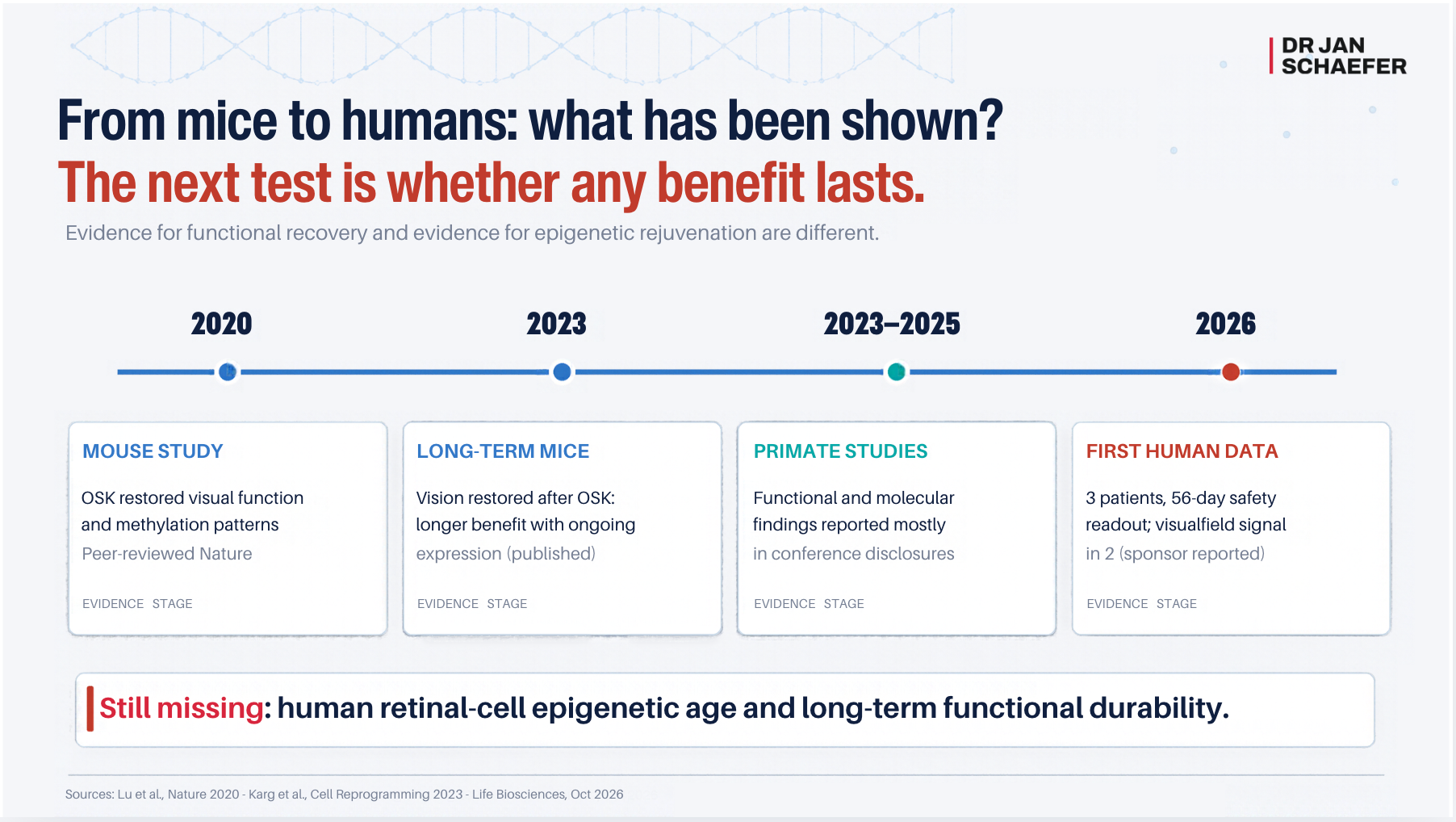
Partial reprogramming tries to stop halfway. In 2016, Alejandro Ocampo and colleagues switched the four genes on in short cycles in mice with a premature-aging disease, which improved several signs of aging and extended their lifespan [5]. In 2020, Yuancheng Lu, David Sinclair and colleagues dropped c-MYC, the gene most closely linked to cancer, and delivered only OCT4, SOX2 and KLF4 (OSK) into the eyes of mice [6]. The treatment restored youthful DNA methylation patterns in retinal neurons, helped damaged nerve fibres regrow after an optic nerve injury, and restored vision in a glaucoma model and in old mice. The effect depended on two enzymes that remove methylation marks, which pointed to the epigenetic reset as the mechanism.
ER-100 is the human version of that mouse experiment.
Why the first human test happens in the eye
The target cells are retinal ganglion cells. These neurons sit in the retina, and their long fibres form the optic nerve, which carries visual signals into the brain. Anatomically, they belong to the central nervous system. They do not divide, and when they die, the body does not replace them. In glaucoma they die gradually over years, while in NAION (non-arteritic anterior ischemic optic neuropathy) a sudden loss of blood supply damages the optic nerve. The trial includes both conditions [7].
The eye also suits a first test for practical reasons. An injection into the gel that fills the eye reaches the retina with a small dose, the eye is a closed compartment that limits exposure to the rest of the body, and doctors can measure what the patient sees.
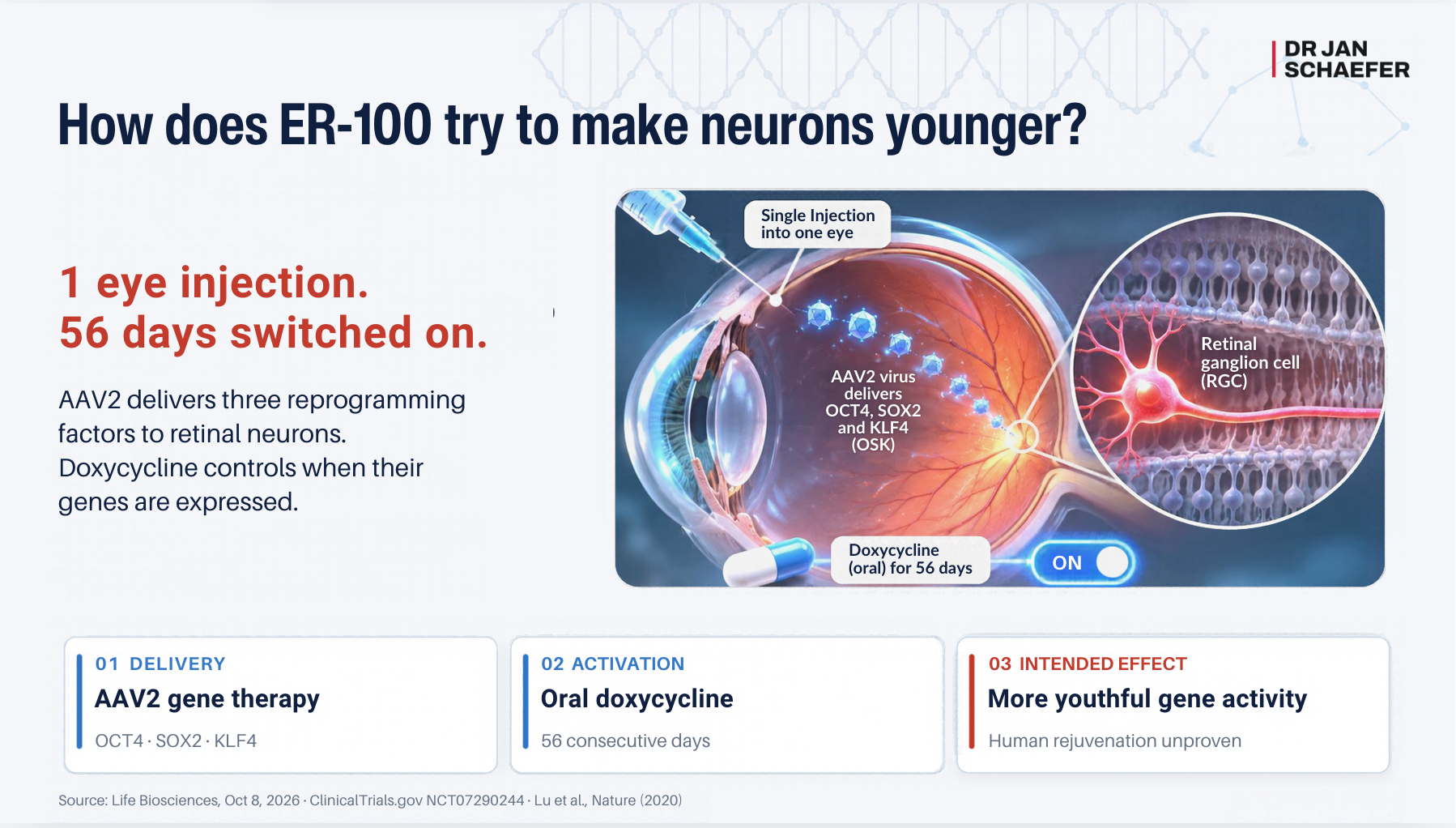
In the trial, a modified virus that does not cause disease, called AAV2, carries the three OSK genes into one eye. The genes stay silent until the patient takes doxycycline, a common antibiotic, which acts as an on switch. Patients take it daily for 56 days, and when they stop, the genes switch off again. A tapering course of the steroid prednisolone limits inflammation caused by the immune reaction to the virus [1].
What three patients can tell us, and what they cannot
The first readout covers 3 patients with open-angle glaucoma at the lowest dose. None had a serious adverse event, a dose-limiting toxicity or an adverse event of special interest. Other adverse events occurred, and the company attributed all of them to the injection procedure, the steroid or existing conditions. The independent safety board then recommended moving to a dose three times higher [1].
The efficacy signal needs more care. The Humphrey visual-field test shows small lights of varying brightness at fixed points across the field of view and records the dimmest light the patient can detect at each point. Sensitivity is measured in decibels, and an improvement of 4 dB means the patient now detects a light about 2.5 times dimmer at that point. In 2 of the 3 patients, at least 28% of the test points improved by more than 4 dB [1].
That number counts test locations in two people, so a headline that turns it into 28% better vision misreads the result.
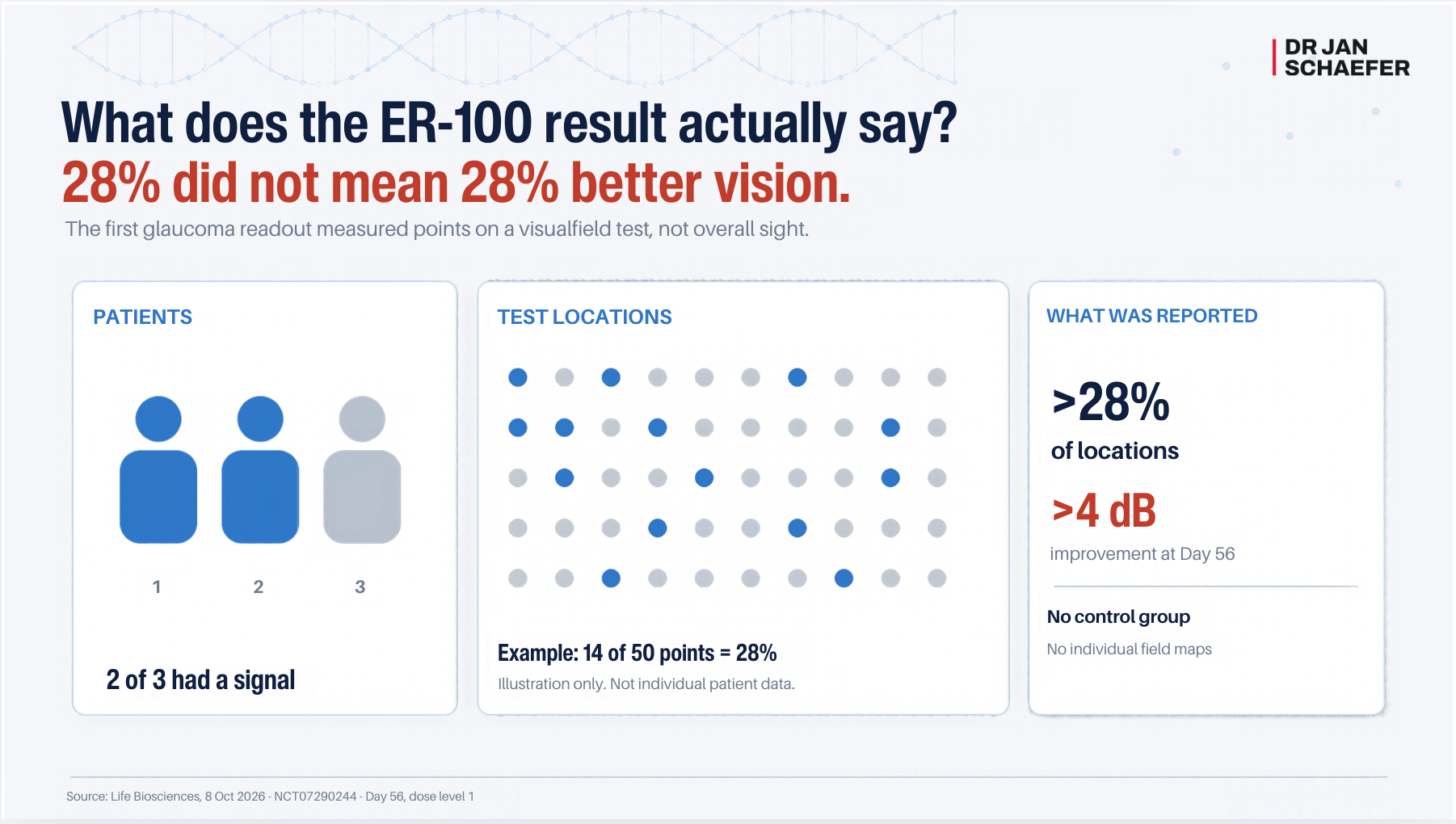
Several things limit how much weight this signal can carry. Visual-field results in glaucoma fluctuate from one test to the next, especially in damaged areas, and patients often score better simply because they have done the test before. The trial has no control group, so there is no comparison with untreated eyes followed the same way. And the company has not released the individual visual-field maps or objective measures such as electrical recordings from the retina (pERG) or retinal imaging (OCT), which would show whether the gains are consistent and real at the tissue level.
The safety result deserves the same scrutiny. Zero serious events in 3 patients sounds reassuring, but if the true risk of a serious event were 10%, you would still see zero in three patients 73% of the time. Statistically, 3 clean patients are compatible with a true risk as high as 63%. The safety board's decision to escalate means the early data looked acceptable to the people who saw them in full, which is a lower bar than showing that the therapy is safe.
Paul Knoepfler, a stem cell biologist at UC Davis, said in February that the approach is "more than a bit oversold within the longevity field" and called the trial "an extraordinarily high-risk study" [8]. Those comments came before the data, and the first 56 days have not proven him wrong or right.
Better vision would still not prove younger cells
Nobody has measured the epigenetic age of these patients' retinal cells, and in a living person nobody easily can, because taking a biopsy from the retina would damage it. So even if the visual-field gains hold up, they could come from protecting stressed neurons rather than from making them younger. Function and biological age are different measurements.
A therapy can also rescue neurons that are alive but failing, or it can regenerate neurons that are already lost, and these are two different outcomes. In August I wrote about a woman who received injections of her own mitochondria into both eyes after an injury to her optic nerves. The authors of that case described their hypothesis as "rescue rather than regeneration," and the same distinction applies to ER-100. Two different repair strategies were tested in the human eye within weeks of each other this year, which shows where the frontier of this field currently lies.
Repair and maintenance are different games
Most consumer longevity products work on maintenance, lowering the rate of damage or measuring it, while reprogramming aims to repair damage that has already happened. When you rank both by the strongest human evidence behind them, the picture looks like this.
The basics have the strongest evidence. Blood pressure is the clearest example. In a meta-analysis of 48 randomised trials with 344,716 participants, each 5 mmHg reduction in systolic blood pressure lowered the risk of major cardiovascular events by about 10% [9]. Those are hard outcomes from randomised trials, which is the highest level of evidence medicine has.
Most promoted supplements and off-label drugs sit in the middle. Their strongest data usually come from animals plus small human trials that measure biomarkers. NMN is a good example. In a trial with 25 postmenopausal women with prediabetes, 10 weeks of NMN improved insulin sensitivity in muscle, while fasting glucose did not change [10]. Rapamycin extended lifespan in mice [11], and the human trials on aging so far are small and measure markers rather than disease or survival.
Reprogramming has the thinnest human evidence of all. It is the only category of the three that aims to restore lost function, and its human data come from 3 patients over 56 days.
This is where my earlier article on the “Two modes of aging” comes in. Raz, Alon and colleagues fitted a damage-accumulation model to survival data from nine species, from bacteria to humans [12]. In short-lived animals such as mice, damage tends to pile up faster than the body can clear it, so a one-time intervention can do lasting good, whereas in humans damage seems to stay close to a balance point that slowly drifts upward, so a short disturbance is expected to fade as the system returns to its previous level.
When I wrote about that paper, I noted that one round of cellular reprogramming might look dramatic in a short-lived animal and still fade in a person. ER-100 is exactly that kind of intervention, a single course of 56 days. If the two-modes model holds, a repair therapy will only last if the body also produces damage more slowly afterwards. Repair would then depend on maintenance, and the two strategies would work together, with neither one replacing the other.
The next test is what happens when the switch goes off
The mouse data already hint at how this could play out. In 2023, Karg and colleagues treated glaucomatous mice with OSK after vision loss had occurred [13]. Two months of OSK restored their vision. After the researchers stopped the doxycycline, gene activity returned to baseline within 4 weeks, the improvement held for about a month, and vision then declined gradually, although it stayed above the untreated glaucoma level for months. Mice with continuous expression kept their restored vision for 11 months. The study used only female mice, and Life Biosciences funded it.
For the human trial, this makes durability after the doxycycline stops the result to watch. The data that will matter most over the coming months are the safety results at the higher dose, repeated visual-field tests with maps for each patient, objective measures such as pERG and OCT, and above all whether any benefit persists months after patients stop the doxycycline. The trial plans to enrol 18 participants, including a group with NAION, and to follow them for up to five years [7]. The company has also reported results in primates at scientific conferences, but those data have not been published for independent review.
Why a glaucoma trial matters for your brain
The retina is the one part of the central nervous system that doctors can inject, image and test from outside the skull. That makes it the natural first place to ask whether old neurons can work better again after an epigenetic reset.
The brain is the obvious next target. Normal cognitive aging seems to involve neurons that are still alive but whose connections work less well, more than large-scale neuron loss [14], which is the situation in which a rescue strategy would make most sense. A company called YouthBio Therapeutics is developing YB002, a partial reprogramming gene therapy for Alzheimer's disease. It improved cognition in old mice and received supportive feedback from the FDA in September 2025, but it has not yet entered human trials [15].
For readers whose main interest is keeping their brain sharp, the practical point for the next decade lies on the maintenance side. In the SPRINT MIND trial, intensive blood-pressure control lowered the risk of mild cognitive impairment by 19%, although the reduction in dementia was not statistically significant [16]. That is a randomised result in 9,361 adults, and no reprogramming therapy will reach that level of evidence for years.
How to read the next reprogramming headline
ER-100 will produce more headlines in 2027, and some of them will say that aging has been reversed in humans. Four checks will tell you how much a new result adds.
- Count the patients and look for a comparison group. Three people without a control can show safety signals, not efficacy.
- Check what the percentage refers to. A share of test locations is not a share of vision.
- Ask whether anyone measured biological age in the treated tissue. Better function alone does not show younger cells.
- Look at the date of the measurement relative to the end of treatment. A benefit that disappears weeks after the doxycycline stops would fit the two-modes prediction.
2026 is the year repair-based longevity medicine reached human patients, three of them, one eye each. Their results cannot show that partial reprogramming works in people, and the trial was never designed to show that yet. They do show that scientists are now testing it in people instead of mice, and the data on durability over the coming months will tell us whether a single course can outlast the damage that a human body keeps producing.
A note on the evidence: the human findings come from an interim, open-label safety study in 3 patients, reported by the sponsor without patient-level data. The visual-field signal is exploratory and uncontrolled. No human data show epigenetic rejuvenation. The supporting mechanism work is preclinical, in mice. Nothing here is a treatment recommendation, and ER-100 is available only inside the clinical trial.
Sources
- Life Biosciences. Life Biosciences announces first-in-human data from ongoing Phase 1 trial evaluating ER-100 in optic neuropathies. Press release, 8 October 2026.
- Takahashi K, Yamanaka S. Induction of pluripotent stem cells from mouse embryonic and adult fibroblast cultures by defined factors. Cell. 2006;126:663–676.
- The Nobel Prize in Physiology or Medicine 2012. NobelPrize.org.
- Abad M, et al. Reprogramming in vivo produces teratomas and iPS cells with totipotency features. Nature. 2013;502:340–345.
- Ocampo A, et al. In vivo amelioration of age-associated hallmarks by partial reprogramming. Cell. 2016;167:1719–1733.
- Lu Y, et al. Reprogramming to recover youthful epigenetic information and restore vision. Nature. 2020;588:124–129. doi:10.1038/s41586-020-2975-4
- ClinicalTrials.gov. NCT07290244 (LB100-001).
- IFLScience. World-first trial to reprogram broken cells in glaucoma begins in humans, but is it just hype? 17 June 2026.
- Blood Pressure Lowering Treatment Trialists' Collaboration (Rahimi K, et al.). Pharmacological blood pressure lowering for primary and secondary prevention of cardiovascular disease across different levels of blood pressure. Lancet. 2021;397:1625–1636.
- Yoshino M, et al. Nicotinamide mononucleotide increases muscle insulin sensitivity in prediabetic women. Science. 2021;372:1224–1229.
- Harrison DE, et al. Rapamycin fed late in life extends lifespan in genetically heterogeneous mice. Nature. 2009;460:392–395.
- Raz N, Yang Y, Pridham G, et al. A damage accumulation model identifies distinct aging regimes across species. Nature Aging. 2026;6:1330–1340. doi:10.1038/s43587-026-01138-7
- Karg MM, et al. Sustained vision recovery by OSK gene therapy in a mouse model of glaucoma. Cellular Reprogramming. 2023;25:288–299.
- Morrison JH, Hof PR. Life and death of neurons in the aging brain. Science. 1997;278:412–419.
- YouthBio Therapeutics. YouthBio Therapeutics announces positive FDA INTERACT feedback for YB002. Press release, 25 September 2025.
- SPRINT MIND Investigators (Williamson JD, et al.). Effect of intensive vs standard blood pressure control on probable dementia: a randomized clinical trial. JAMA. 2019;321:553–561.


