

Google tested a team of AI specialists on real health questions and published the results in Nature. The answer depends on the kind of question more than on the AI.
By Dr. Jan Schaefer
You wake up and check your health tracker's sleep data. Your ring shows a readiness score of 48 out of 100 this morning. Bummer! The sleep screen says that deep sleep was short again, and your step counter says that you walked less than usual yesterday. You get up, get ready and over the first coffee you type a question into a chatbot AI: "How is my physical activity level related to my sleep quality? Do I need to exercise more?" You get your AI answer within seconds. It quotes your own numbers back to you and ends, quite confidently, with a plan for more steps. Now, how much can you really trust or rely on this answer?
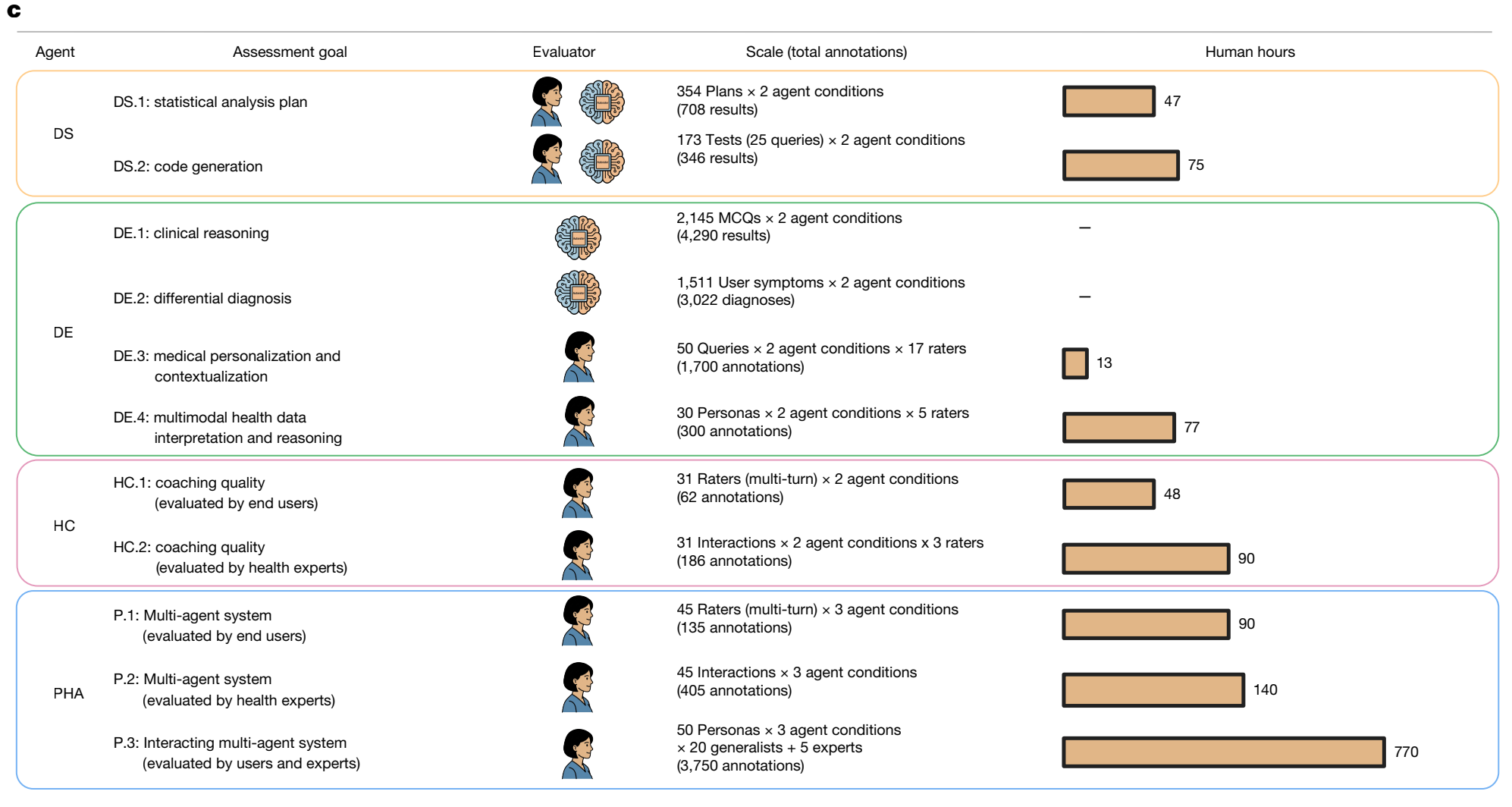
The question posed to an AI chatbot comes word for word from a figure in a paper that Google Research and Google DeepMind published in Nature in October 2026 [1]. In this paper the Google team built an AI agent for exactly this kind of question, and end users and health experts tested it in more than 7,000 ratings over more than 1,350 hours. What did they do? The study sorts health questions into 4 kinds of questions, and its results demonstrate how far an AI answer deserves your trust for each kind. The AI which was tested dates from early 2025, so for each kind I will also give an indication if the finding is still relevant for the current chatbot AI on your phone.
People ask a health AI 4 types of question
To find out what people really ask, the researchers read 1,370 real health questions from Google Search, the Gemini chatbot and the Fitbit user forum. They also surveyed 555 Fitbit users and held a workshop with 14 experts [1] and the questions they asked fell into 4 groups:
- general knowledge ("what are the pros and cons of interval training?")
- your own data ("how did my steps affect my resting heart rate in the past month?")
- advice ("at what time should I go to bed?")
- symptoms ("my throat is itchy and I have trouble swallowing, what might be going on?").
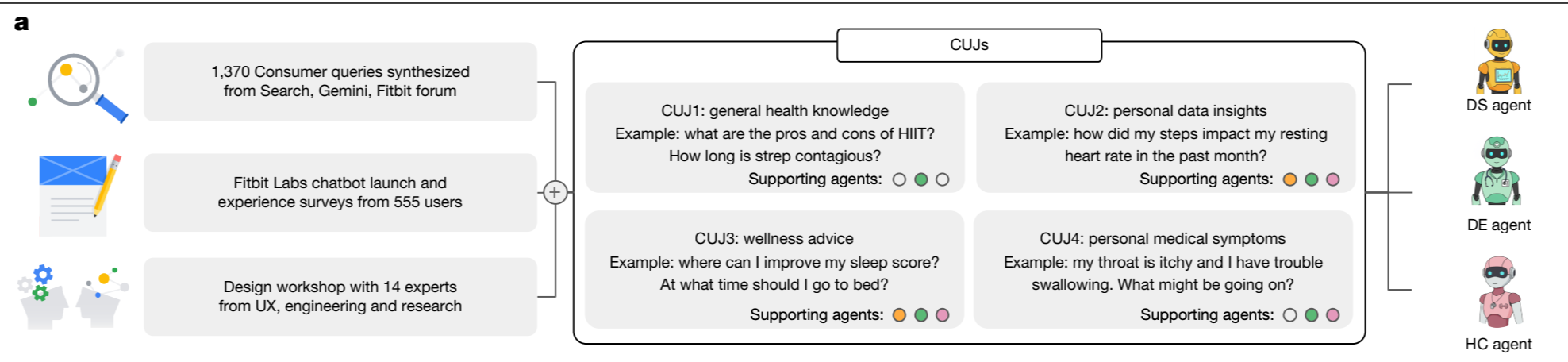
Your morning question touches three of the four. Whether walking relates to your deep sleep is a question about your data. Why exercise might deepen sleep is general knowledge, and whether you should exercise more is a request for advice.
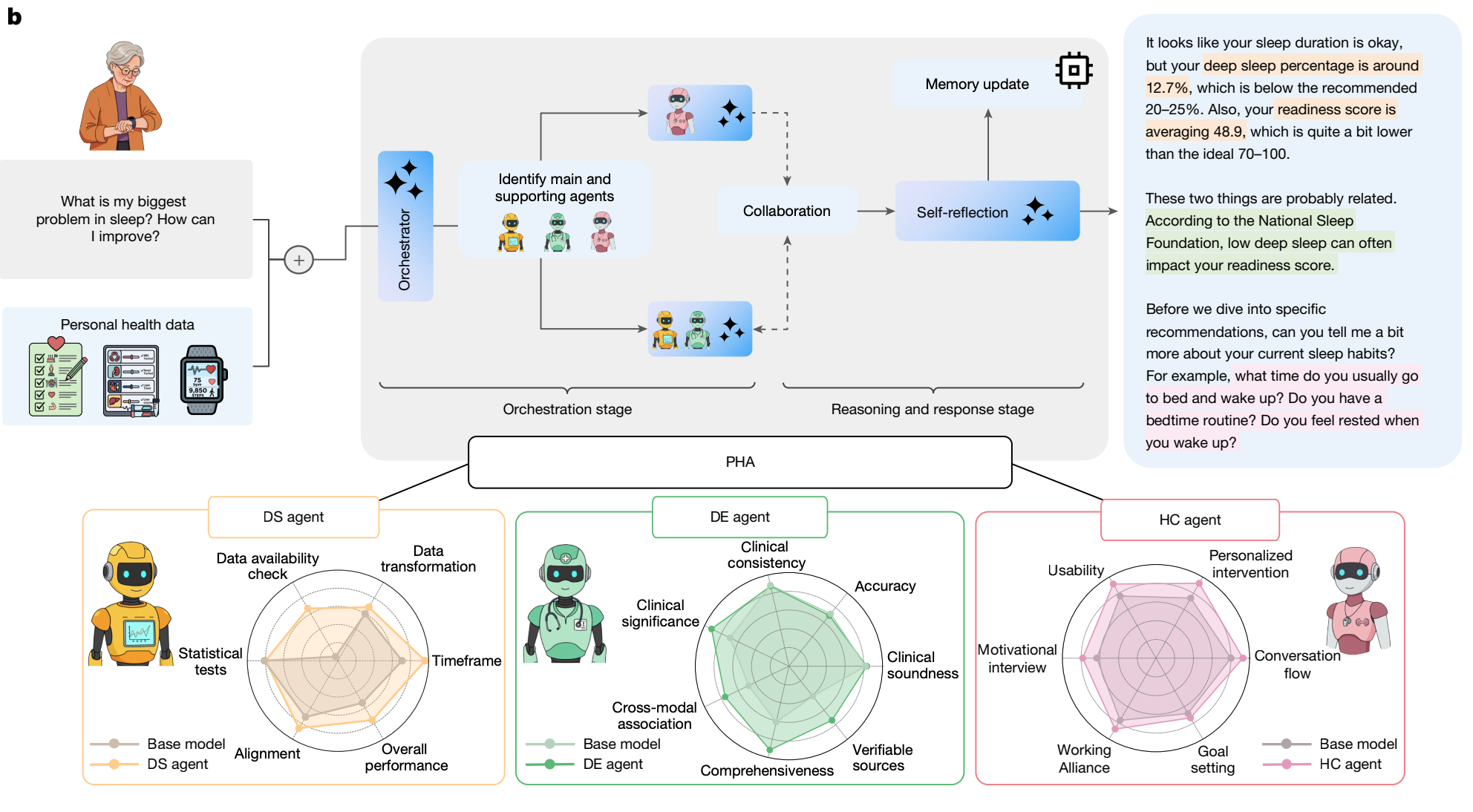
Google's answer to such mixed questions is an AI agent, an AI program of the kind behind ChatGPT or Gemini that can also look up sources, run calculations on your data and decide its own next step. This works like a doctor's assistant who can pull your file, order a test and check a reference book before reporting back. In this study case Google's agent was a team of three such programs, a “data analyst”, a “medical expert” and a “health coach”, plus a “coordinator” that decides who works on your question and in which order. The coordinator works like the practice manager who reads your request and books the right colleagues in the right sequence.
The first kind, general knowledge, is where an ordinary chatbot already does well
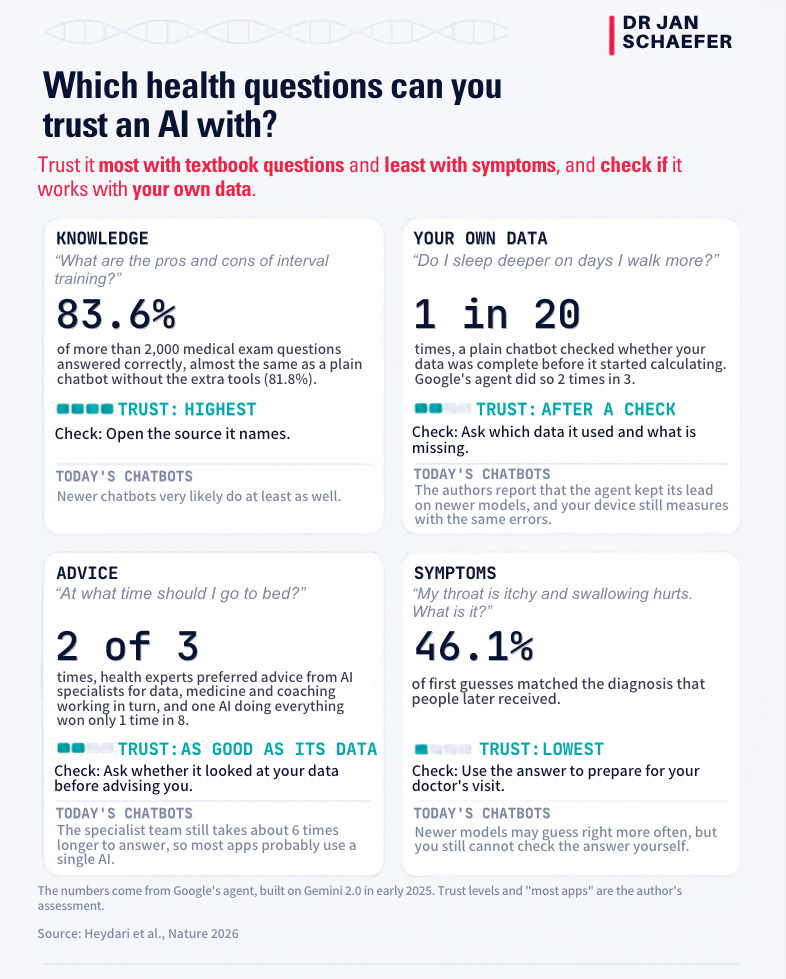
The first test used more than 2,000 multiple-choice questions from board-certification and coaching exams in endocrinology, cardiology, fitness and sleep medicine. The plain AI program, Google's Gemini, answered 81.8% correctly. The medical-expert agent, which searches sources before it answers, reached 83.6% [1]. The textbook knowledge was already inside the plain program, so the extra machinery added less than 2 percentage points.
For this kind of question I would trust an AI answer the most of all four, as long as you open and check the source it names.
So, how does this translate to today's chatbots? The plain model in this test was Gemini 2.0 from early 2025. In the supplement, plain Claude Sonnet 4.5 scored about 1 to 2 points higher than Gemini 2.0 in each of the four specialties, while the smaller GPT-5-mini scored 7 to 9 points lower [1, Supplementary Table S14]. A newer chatbot is therefore not automatically a better one, and checking the source stays worth the minute it takes.
Since the plain program already knew its medicine this well, the large gains in this study came from the next kind of question, the one about your own data.
With your own data, a plain chatbot rarely checks whether the data is complete
Questions about your own numbers look simple, but they hide a step that a careful doctor or data scientist always takes first. Before you calculate anything, you check whether there is enough data, which days or nights are missing, and what the numbers actually measure. Google rated every analysis plan on exactly this check, with a scoring method it had validated against 10 expert data scientists. The plain AI program passed in 5.3% of its plans. That is about 1 in 20. Google’s data-analyst agent, by contrast, passed in 66.5%, or about 2 in 3 [1].
This works like a blood test. An experienced doctor knows what a glucose value means, yet before reading it he checks whether you were fasting, whether the sample sat too long before it reached the lab, and whether the tube carries your name. The plain AI program skipped that step 19 times out of 20 and went straight to the value.
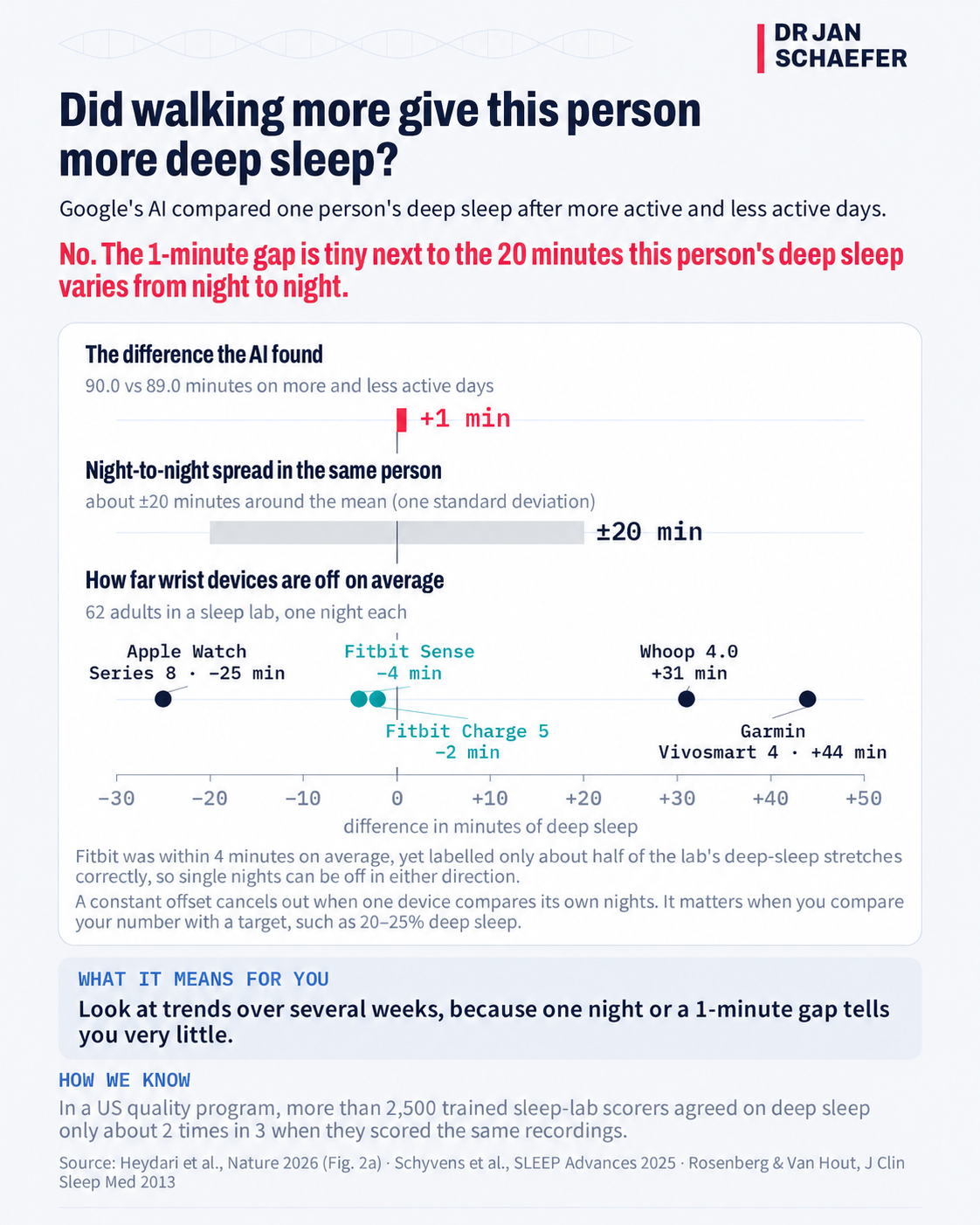
What difference does the check make in practice? One figure in the paper shows it. There, a user asks a narrower version of your morning question: “Do I get more deep sleep the days that I stay more active?” The agent first defined the more active days for this person as days above their median of 7,971 steps. On those days deep sleep averaged 90.0 minutes, and on the other days 89.0 minutes [1]. One minute. Over the same period, this person’s deep sleep swung by about 20 minutes from one night to the next. Steps and deep sleep also barely moved together, with a correlation of 0.14, where 0 means no link and 1 a perfect one. So for this person, walking more showed no meaningful link with deep sleep. When the full agent team answered your exact morning question, it reached the same verdict and reported only a weak link between daily steps and the sleep score.
A physician’s note on deep sleep. Even when the AI handles your data perfectly, the deep-sleep number itself remains an estimate. Your ring or watch infers it from movement and heart rate, whereas a sleep lab reads brain waves, and even the lab finds this stage hard to score. In the quality program of the American Academy of Sleep Medicine, more than 2,500 trained scorers rated the same recordings. They agreed on deep sleep in only 67.4% of the 30-second stretches, compared with 82.6% across all sleep stages [2].
Wrist devices do worse, as a 2025 Belgian study shows. In it, 62 adults slept one night in a sleep lab while wearing several of six popular wrist devices [3]. The devices labelled between 47% and 70% of the lab’s deep-sleep stretches correctly, and the two Fitbit models, the brand behind Google’s data, got about half of them right. On average, the Whoop overestimated deep sleep by 31 minutes and the Garmin by 44, while the Apple Watch came out 25 minutes short. The Fitbits came within 4 minutes of the lab on average, but only because their errors on single nights ran in both directions and cancelled each other out. A 2024 study from Boston points the same way, with a Fitbit Sense 2 that came out about 15 minutes short on deep sleep in 35 healthy adults [4]. Oura funded that study and its lead author advises the company, which is worth knowing, because the Oura ring came out best.
These average offsets matter most when an AI compares your number with a fixed target. In the paper’s very first figure, Google’s own agent tells a user that 12.7% deep sleep is “below the recommended 20–25%” [1]. As a physician, I would question that sentence for two reasons.
- First, the device may be off by up to 44 minutes on average before any comparison starts.
- Second, the share of deep sleep falls by about 2 percentage points per decade of adult life until around age 60, according to a meta-analysis of 65 studies [5], so a single target for all adults has no basis.
Back to the 1-minute difference, then. A device’s average offset does not explain it away, because an offset that stays constant cancels out when one device compares its own nights. The 20-minute swing from night to night does, together with a device that labels only about half of the deep-sleep stretches correctly and so adds its own error to every single night.
Trends over several weeks carry information. A single night, or a 1-minute gap, carries very little.
Today's chatbots. None of these measurement problems shrinks with a newer AI model, because no model can make your ring measure better. The supplement to this paper shows that newer chatbots check the data more often than Gemini 2.0 did. Even so, plain GPT-5-mini and Claude Sonnet 4.5 passed the check in only about 1 of 5 analysis plans (19.9% and 17.5%), while the same two models built into Google's agent design passed in about 9 of 10 (92.6% and 88.7%) [1, Supplementary Table S8].
Advice improves when the AI reads your data before it coaches you
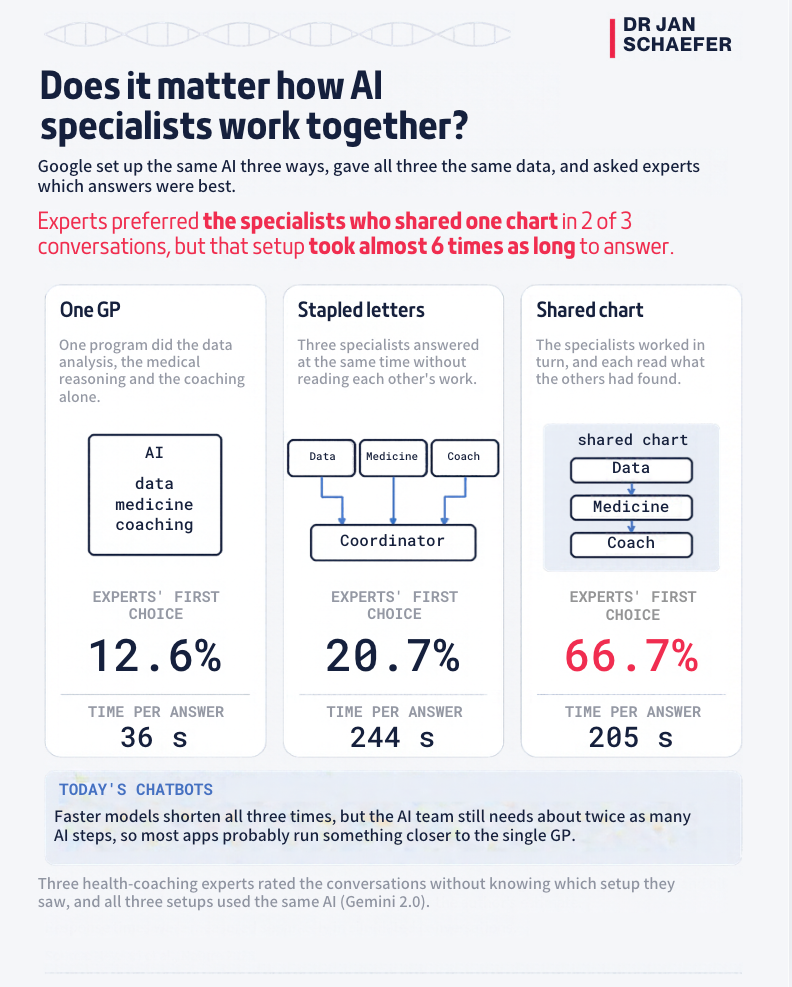
Most people do not stop at the data, because they want to know what to do next. For that, Google compared 3 ways of setting up the same AI program, all working with the same data [1]:
- In the first setup, one program did everything alone.
- In the second, the three specialists worked at the same time, none of them saw what the others had written, and the coordinator merged their answers at the end.
- In the third, they worked one after the other, so each specialist read what the others had found before adding its own part.
This works like three kinds of practice. In the first, one GP does the lab work, the diagnosis and the lifestyle advice in a single 10-minute slot. In the second, you see a lab technician, a physician and a coach on the same day, but they never speak to each other, and a clerk staples their three letters together. In the third, the lab report goes to the physician, the physician's note goes to the coach, and all three write in one shared chart.
Which practice would you choose?
Three health-coaching experts answered that question in the study for Google without knowing which setup had produced which conversation. What was the result?
They picked the shared chart as best in 66.7% of conversations, the stapled letters in 20.7% and the single GP in only 12.6% [1]. The paper also shows why the chart mattered. A coach that works without the data analyst would ask you "how long did you sleep last week?", although your watch already holds the answer, and the authors note that such questions cost the user both effort and trust.
A second finding will sound familiar to anyone who has coached patients. When the team gave a single program one long instruction to act as a coach, it either gave advice before it understood the person or kept asking questions and never got to the advice at all [1]. Google therefore added a separate step whose only job is to decide when enough is known to give advice. Good human coaches make that judgement all the time, usually without noticing.
But there was also a slight downside to the AI team effort that came at a cost. The shared-chart version needed 205 seconds per answer, while the single program needed 36, because the team calls the AI about twice as often [1]. I assume future/faster models will shorten both times, but they will not completely remove that difference. Whoop and Oura already sell AI coaches inside their apps, as the paper notes [1], and few companies will ship an app that makes you wait minutes for a reply. I therefore expect that the coach on your phone works much more like the single GP than like the shared chart.
With symptoms, you cannot tell a right answer from a wrong one
Symptoms are the hardest kind of question, both for the AI and for you, because you have no way to check the answer yourself. Google tested its medical-expert agent on 2,000 real symptom reports from people who later told the researchers which diagnosis they had received. The agent's first guess matched that diagnosis in 46.1% of cases, which was 4.7 percentage points better than a leading earlier diagnosis agent built on Gemini [1]. In other words, more than half of its first guesses missed.
Users and experts also judged the same answers very differently, and that makes the problem worse. On complex questions, end users rated the full agent team on average 4.6% better than the simpler setups, while experts saw an advantage of 17.1%, nearly four times as large [1].
Cited sources impressed the users as well. In a smaller test, 17 users rated the medical-expert agent, which backs its answers with sources, as trustworthy in 96.9% of cases, compared with 38.7% for the plain program.
This works like the difference between a patient and the chief physician on a ward round. The patient judges the bedside manner, the waiting time and whether the doctor seemed to listen, whereas the chief physician reads the chart and checks whether the diagnosis and the treatment were right. Citations, in turn, work like the framed diplomas on the consulting-room wall. They show that training happened, but they cannot show that today's diagnosis is correct.
In one of my last Linkedin articles, people in a Wharton experiment kept a wrong AI answer 80% of the time, and a fluent symptom answer with sources attached invites exactly that kind of trust.
The authors therefore conclude that a future system should help people record symptoms, identify patterns, prepare questions and find their way through care, while it avoids diagnostic claims [1]. That role works like a good medical assistant who takes your history before the doctor comes in, which makes the visit better without replacing it.
Newer models do not solve this problem either. In the supplement, plain GPT-5-mini and Claude Sonnet 4.5 named the right diagnosis first in only 38% and 42% of cases [1, Supplementary Table S15], and you still cannot check the answer yourself.
What this study cannot tell you
Google compared its system only with weaker setups of its own design, never with doctors or with the health chatbots people already use. In the main test, moreover, participants played personas built from an earlier Fitbit study instead of asking about their own bodies. All wearable data came from Fitbit, and the coaching study had only 31 participants, 25 of them men. Nobody measured whether anyone slept better or became healthier, which the authors state themselves. Alphabet funded the work, and most of the authors are current or former Alphabet employees [1]. If Google found these weak points in its own best effort, I would expect them to be even larger in a consumer app that was built in a hurry.
Why a 2026 study tests the AI of 2025
You also may wonder why a study published in late 2026 worked with a model from early 2025, which already looks dated today. That delay turns out to be typical for the field. A September 2026 preprint that analysed 11,628 medical AI studies found that the time between the newest model a study tested and the study’s publication grew from about 4 months in 2023 to about 18 months by mid-2026 [6]. Randomised trials, the most rigorous design, tested models more than a year older than other studies did. So the percentages in any AI study describe the AI of a year or two ago, while findings about devices and about people age far more slowly. As new models come out ever faster, I expect this gap to become a bigger problem for anyone who makes decisions based on such studies. I don’t have a solution for it. Google at least softened the problem in this study by releasing its code and its test set, so anyone can rerun the same test on today’s models [1].
So what can an AI tell you about your readiness score of 48 from the beginning of the article?
That depends on which of the 4 questions you ask.
Ask what a readiness score measures, and an ordinary chatbot answers about as well as a good textbook.
Ask whether your walking relates to your sleep, and even Google’s agent could only report a weak link in this person’s data. A sleep physician would add that a 1-minute difference is tiny next to how much one person’s deep sleep varies from night to night.
Ask how to train this week, and the advice gets better when the AI reads your data before it coaches you.
Ask what a new symptom means, and the answer should still belong with your doctor, because you cannot tell a right guess from a wrong one.
That may sound sobering, but the same study is also the reason I am optimistic. When Google built today’s chatbots into its agent design, they went from checking the data in about 1 of 5 analysis plans to about 9 of 10. The models stayed the same, only the way of working changed, and Google has published the code for anyone to build on. Nothing stops the apps on your phone from adding the same check to the question that matters most to you, the one about your own body. Until they do, an answer about your body is only as good as the data and the question behind it, and both of them belong to you.
Sources
- Heydari AA, Gu K, Srinivas V, et al. The anatomy of a personal health agent. Nature 2026;659:197–207.
- Rosenberg RS, Van Hout S. The American Academy of Sleep Medicine inter-scorer reliability program: sleep stage scoring. J Clin Sleep Med 2013;9(1):81–87.
- Schyvens AM, Peters B, Van Oost NC, et al. A performance validation of six commercial wrist-worn wearable sleep-tracking devices for sleep stage scoring compared to polysomnography. SLEEP Advances 2025;6(2):zpaf021.
- Robbins R, Weaver MD, Sullivan JP, et al. Accuracy of three commercial wearable devices for sleep tracking in healthy adults. Sensors 2024;24(20):6532.
- Ohayon MM, Carskadon MA, Guilleminault C, Vitiello MV. Meta-analysis of quantitative sleep parameters from childhood to old age in healthy individuals: developing normative sleep values across the human lifespan. Sleep 2004;27(7):1255–1273.
- Bin Tareaf R, Al-Rajab M, Loucif S. The widening evaluation gap in medical large language model research 2023 to 2026. arXiv 2609.11770, 2026 (preprint).


