

A new longevity headline shows up almost every week. Some drug adds months to a mouse's life, some pathway slows aging in worms, some compound keeps flies alive longer. The reflex is always to quickly ask whether the same thing will work in humans.
Raz, Alon and colleagues, just published an article in Nature Aging with the title ""A damage accumulation model identifies distinct aging regimes across species.", suggesting that question arrives too soon. There's a prior one often not asked enough: is the animal in front of us even aging the way we age?
Their work says it might not be, and that carries some relevant consequences for how the field reasons for translation from animals to humans.
What the paper actually did
A mouse, a dog and a human all decline in familiar ways with age. Disease risk rises, function fades, mortality climbs. What differs, by orders of magnitude, is the clock. The authors set out to explain why.
They used the saturating removal model. It treats biological damage as a quantity that gets produced, gets cleared, gets jostled by random noise, and kills the organism once it builds past a threshold. The word "damage" stays deliberately loose, standing in for senescent cells, DNA lesions, misfolded proteins, failing mitochondria, a tiring immune system, or some mixture of all of them. The model stays agnostic about which molecule matters, and asks instead whether different kinds of damage move through the same underlying math.
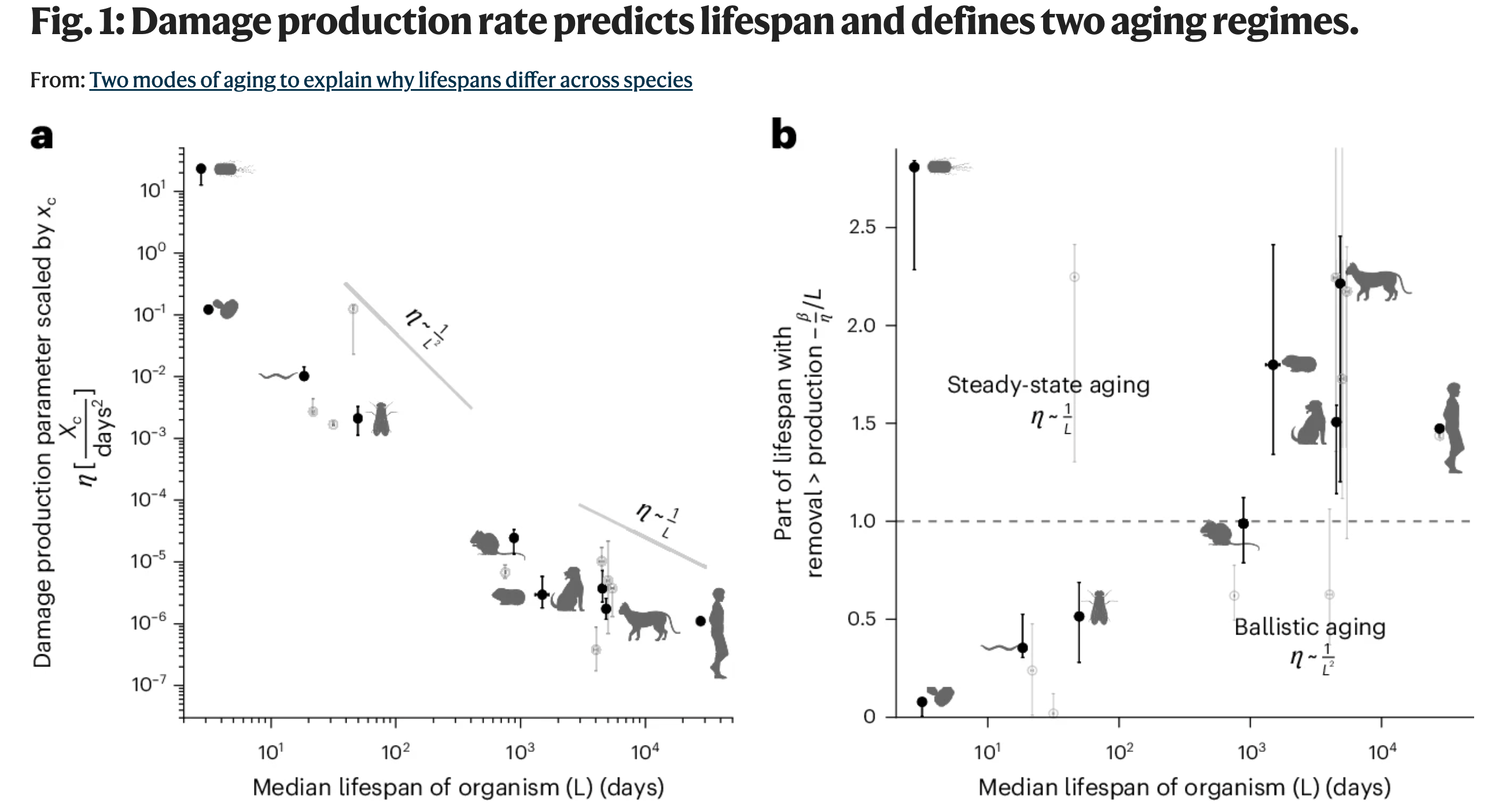
They fitted it to survival data from 9 species, spanning E. coli that last 68 hours to humans who reach around 80 years. One result carries well beyond the journal. The single best predictor of how long a species lives was the speed at which it generates damage. The removal rate barely registered by comparison. The production rate ranged across seven orders of magnitude, with the long-lived species sitting at the slow end.
The two modes of aging
Two patterns came out of this fit. The first they call ballistic aging. Damage gets made faster than it can be removed, so it piles up over a lifetime. Yeast, worms, flies and mice belong to this group.
The second is quasi-steady-state aging. Production and clearance stay close to balanced through most of life, so damage rises slowly, tracking a set point that itself drifts upward. Humans, dogs, cats and guinea pigs sit on this side.
Which means a human and a mouse may run on genuinely different rules for how damage behaves across a lifetime.
Mice even complicate the picture in a way worth pointing out. They turn out to be hybrids, spending the first half of life in something close to our quasi-steady state, then tipping into ballistic aging for the back half. The animal the field leans on hardest for human data spends its old age in the regime that resembles us least.
Why this complicates the idea of an "aging reset"
A great deal of the longevity rationale and surely a lot of longevity marketing rests on one mental leap, from "it worked in the mouse" to "so it might work in humans as well." This paper puts pressure on that leap.
In a ballistic organism, a one-time intervention can do lasting good, because the damage it clears had been accumulating and stays gone. A quasi-steady-state organism behaves differently. Knock its damage down with a brief intervention and it tends to climb back toward where it started, since the system was holding a balance you only briefly disturbed.
That bears directly on the "reset your biology" pitch you see a lot in the field. A short senolytic course, a single extended fast, one round of cellular reprogramming might look dramatic in a short-lived animal and still fade to almost nothing in a person. The authors are blunt about the prediction: "in quasi-steady-state aging, a transient hit is expected to wash out".
Relevant conclusion
But overstating this in either direction would miss what the paper actually offers. Mouse studies keep their value, and the honest reading of this stays hopeful. It just asks us to be more precise and deliberate when assuming translational potential when confronted with new exiting mouse data. Did the intervention slow the rate at which damage is produced, or only clear what had already gathered? Did anything survive the moment treatment stopped? Crucially, did it shrink the years of disease, or simply move the date of death? And was the animal even in a regime that tells us anything about ourselves? Demanding questions, and the field gets better the day it starts asking them.
In the end, what you're looking at is a mathematical model fit to survival curves. Nobody measured damage inside living human tissue to build it. The authors say as much themselves. The parameters still await experimental testing, and nobody yet knows what the damage variable physically corresponds to from one species or tissue to the next. So hold it as one early and genuinely elegant framework, with the experimental verdict still out.
Either way, this stays one early model for now, and the real clarity will come once its predictions are tested directly. I find that a hopeful place to stand, with answers on the way rather than years off.
Based on Raz, N., Yang, Y., Pridham, G. et al. "A damage accumulation model identifies distinct aging regimes across species." Nature Aging (2026). https://doi.org/10.1038/s43587-026-01138-7


