

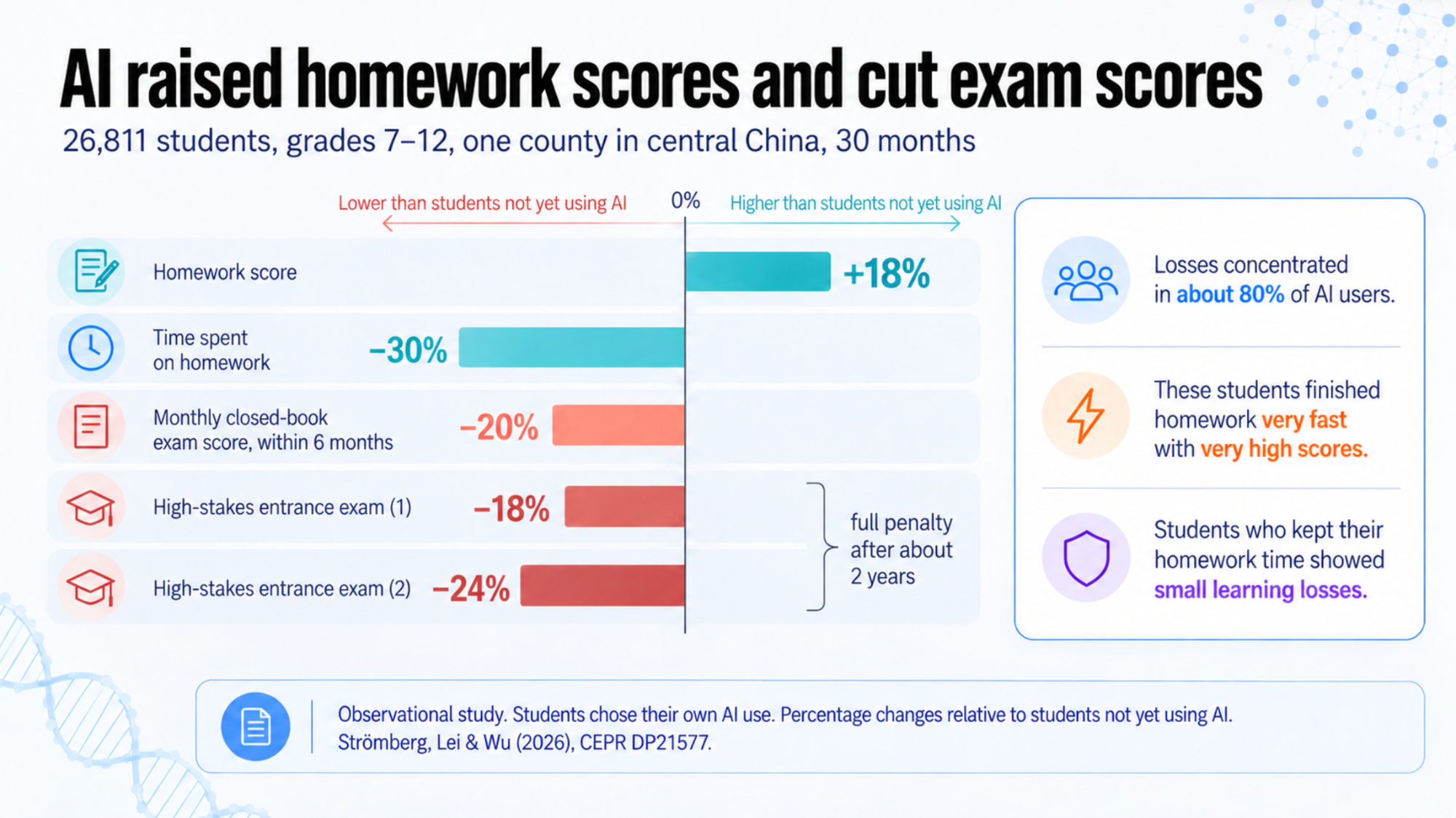
AI raised homework scores by 18% and cut exam scores by 20%. The studies behind these numbers show that the loss depends on how people use the tool, and that the people affected tend not to notice it.
By Dr. Jan Schaefer
For 30 months, three economists followed 26,811 secondary-school students in one county in central China while generative AI tools were introduced in the classroom. They tracked what happened to each student's homework and exam results once that student started using the AI tools [1]. After adoption, homework scores rose by 18% and the time the students spent on their homework fell by 30% [1]. Their exam results moved in the opposite direction. Within six months, scores on the monthly closed-book exams, which the students sat without any help, had fallen by 20% [1]. Scores on the high-stakes entrance exams fell by 18% and 24%. The authors call this drop the generative AI learning penalty, and they found that its full size took about two years to appear [1]. The authors estimated these changes by comparing each student's results before and after they began to use AI with the results of students who had not yet begun. Every figure is therefore a percentage change relative to students without AI.
The homework figures describe the kind of result that AI products are sold on. A student who hands in better work in less time looks like a success, and so does an employee who drafts a report in half the usual time. Companies that sell these tools therefore have every reason to measure that gain. But they have far less reason to measure whether their users can still do the work once the AI tool is closed, because a result like the Chinese exam scores would not help them sell anything. In a study published in September 2025, Handshake AI tested adults on its own platform [2]. One hour with an AI tutor raised their scores on practice questions for the GRE, the admissions test for American graduate schools, as much as one hour with a human tutor [2]. But the researchers did not test the same adults a week later, so the study cannot say how much of that gain lasted [2]. Outside the industry, the Education Endowment Foundation, a non-profit research organisation in London, committed up to £2.5 million in June to rigorous studies of how generative AI affects learning, understanding, memory and problem-solving [3].
The exam losses were concentrated among about 80% of the students who used AI [1]. These students finished their homework unusually fast and scored unusually high on it, a pattern the authors read as copying answers from the chatbot [1]. Psychologists call this cognitive offloading, meaning the use of a tool or an action to reduce the mental work that a task requires [4]. The remaining fifth kept spending about as much time on their homework as students who did not use AI at all. Their exam results showed only small learning losses [5]. Because the students decided for themselves how to use the tools, this comparison shows an association and no more. The students who kept working through their homework may have differed from the others in motivation or in other ways, so the data cannot prove that the homework time itself protected them.
The losses were largest among younger students, among boys and, most relevant for a professional audience, among the students who were already doing best [1].
That contradicts the obvious explanation that AI only harms weak students who would have struggled anyway.
Is this effect like "cognitive cancer", as one critic claims?
The Chinese paper has already been read as proof of a disaster. Benjamin Riley builds an essay in Education Next on it and calls generative AI "cognitive cancer" [6]. As a medical diagnosis, the comparison does obviously not fit the evidence. A malignant tumour grows on its own once it is established, and removing the carcinogen that started it does not stop it. In the studies described here, the size of the loss depended on how people used the AI tool from day to day. In the randomised trial described below, a change in the design of the AI tool was enough to remove it. The closer medical picture is disuse, in which a capacity weakens because a device now does its work for the person. But nobody has yet tested whether the lost skill comes back once people stop outsourcing.
On the scale of the problem, Riley has a stronger case than earlier critics of technology had. The psychologist Daniel Schacter reviewed the research on technology and memory in 2022, before AI chatbots came into general use. He found clear effects on specific tasks, such as remembering a route that a navigation system had planned, and very little evidence of any broader decline in memory [7, 8]. The Chinese students, by contrast, lost ground in nine school subjects, and their losses kept growing for two years [1].
A trial in Turkey shows that the design of the tool decides the outcome
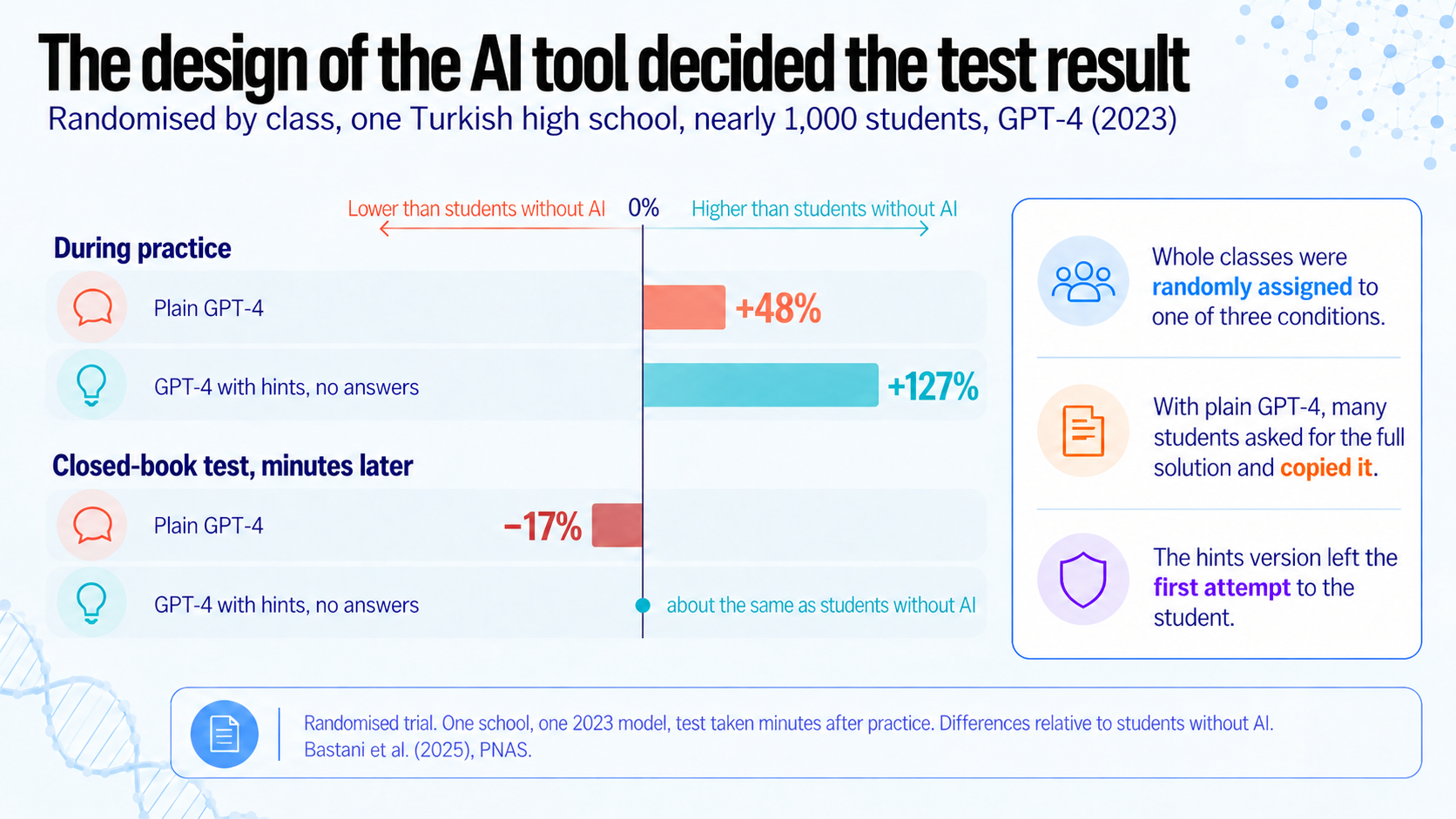
The Chinese data cannot show whether the tool caused the losses or whether weaker learners simply relied on it more. The clearest answer so far comes from a randomised trial in a large high school in Turkey, published in PNAS in 2025 [9]. Nearly 1,000 students in grades 9 to 11 practised maths in four sessions of 90 minutes each. Whole classes were randomly assigned to practise without AI, with GPT-4 as it was released in 2023, or with a version of GPT-4 that teachers had loaded with hints and instructed never to give away the answer. What the researchers randomised was therefore the design of the tool, while each student still decided how to use the version they had been given.
During practice, both AI groups looked far better than the students without AI, with the plain GPT-4 group scoring 48% higher and the hints group 127% higher [9]. On a closed-book test a few minutes later, the result reversed for the plain GPT-4 group, which scored 17% lower than the students who had practised without AI [9]. The hints group scored about the same as the students without AI [9]. The chat logs explain the difference, because many students with plain GPT-4 asked for the complete solution and copied it, whereas the hints version left the first attempt at each problem with the student [9].
Experiments by the psychologists Nate Kornell, Matthew Hays and Robert Bjork show why the first attempt makes such a difference. They asked people to try to answer questions before showing them the answers. These people remembered the answers better afterwards than people who had only studied them, even when their own attempt had been wrong [10]. The education researcher Thomas Nygren advises students to work out their own interpretation and arguments before they ask an AI, so that its answer does not replace their own thinking [3].
Fluent answers make people overrate what they know
Getting answers from a machine also changes how people judge their own knowledge, and this effect was documented for search engines long before chatbots arrived. In a series of 8 experiments with 1,917 participants, the psychologist Adrian Ward asked people to answer general-knowledge questions, some with Google and some from memory alone [11]. Those who had used Google afterwards rated their own ability to think and remember more highly [11]. They also expected to do better on a later test without the internet, and that expectation turned out to be wrong [11]. Ward's conclusion was that people mistake the internet's knowledge for their own.
A 2023 study by Eliseev and Marsh found the same distortion when people had to explain something. Participants who searched online felt better able to explain how zippers work or why leap years exist than participants who read the same information [3, 12]. Yet the searchers' explanations turned out to be less accurate [3, 12]. Marsh suspects that the snippets shown in search results give people a sense of familiarity with a page before they have read it [7]. Nobody has yet tested whether the AI-written summaries that now appear at the top of many search results make this worse [7]. The students in the Turkish trial showed the same blind spot, since those who had practised with plain GPT-4 did not notice that their test performance had fallen [13, 9].
Adults have been studied for hours, never for a year
For adults the evidence is thinner, and most of it comes either from single laboratory sessions or from older technology such as satellite navigation. In a 2010 driving-simulator study, people who had followed GPS directions along a route were afterwards no better at driving it from memory than people who had never driven it at all [7, 14]. A study from McGill University in Montreal later followed 13 drivers for about three years [15]. Those who relied more on GPS during that time showed a steeper decline in their spatial memory [15]. The heavy users had not started out with a poorer sense of direction [15].
A recent experiment by a group in Munich tested whether a simple message could reduce this kind of offloading. In a preregistered online study, 704 adults in the UK practised fraction arithmetic with an AI assistant [13]. After each problem, some of them saw a short message describing how they had just used the assistant, for example that they had asked for the answer without writing anything down first [13]. Those who received these messages asked for the complete answer on about 1 in 9 practice problems instead of about 1 in 6 [13]. On a later test without the assistant, they solved 66% of the problems, compared with 60% for AI users who had received no messages [13]. The statistical range around that improvement in test scores is wide enough to include no effect at all, so the result needs to be repeated before anyone builds on it [13].
None of this evidence shows what daily AI use does to adults over several years, and short studies can mislead in either direction. The Munich study lasted a single session and has not yet been peer-reviewed [13]. The Turkish trial involved one school, one AI model from 2023 and a test taken minutes after practice, and the GPS follow-up rested on 13 people [9, 15]. Short experiments can exaggerate an effect, as a widely cited 2011 paper in Science on the so-called "Google effect" showed when its first experiment failed to replicate in two later attempts [7, 16]. They can also understate one. The Chinese authors warn that because their penalty grew as students used AI for longer, studies that run for only a few weeks may underestimate the long-run cost [5]. No study has yet followed adults who use AI every day over a whole year.
In 4 studies, people did not notice their own decline
Across the research described here, people's own sense of how well they were doing repeatedly failed to match what a test measured. Google users overrated their memory [11], searchers overrated their ability to explain [12], and the Turkish students did not notice that their test scores had dropped [13]. A carefully controlled laboratory study of sleep found the same mismatch. David Dinges and his colleagues restricted healthy adults to 6 hours of sleep or less per night for two weeks. The participants developed cognitive deficits equivalent to up to two nights without any sleep [17]. Their own sleepiness ratings suggest that they were largely unaware of how impaired they had become [17].
For a physician, the lesson is that a person's impression of how sharp they feel is a poor test of how well their brain is working. That holds whether the cause is short sleep or thinking handed over to a machine.
Every strategy for using AI well depends on attention, working memory and judgment, and these in turn depend on the condition of the brain itself.
What can we take away from this
None of this means that offloading is harmful in itself. In a 2015 experiment, students who were allowed to save a file of words they had studied went on to memorise a second list better [7, 18]. The researchers read this as evidence that saving the first file freed memory for the next task [7]. An AI chatbot, however, is a less reliable place to keep information than a saved file, because it writes each answer afresh and can invent errors [7]. The evidence therefore supports handing the AI the storage while keeping the reasoning for yourself.
- Make the first attempt yourself, in writing, before you open the assistant. In the Turkish trial, the version of the tool that left the first attempt to the students also left their test scores intact [9]. In memory experiments, trying to answer before seeing the answer improved later recall even when the attempt was wrong [10]. Writing the attempt down has a second benefit, because it shows you what you do and do not yet understand [3].
- Ask the AI for hints and for objections to your attempt, and ask for the complete answer only at the end. In the Turkish trial, the hints version was the one that protected learning [9].
- Use the AI to store and find facts and documents, and check anything important that it gives you against the original source, because an AI can introduce errors that a saved file cannot [7].
- Treat a run of nights with 6 hours of sleep or less as a risk to your thinking, even when you feel fine. In the Dinges study, two weeks of such nights impaired performance as much as up to two nights without sleep, and the participants barely noticed [17].
In each of the four studies that compared how people felt with how they actually performed, the feeling was the more optimistic of the two.
None of this makes me any less of an advocate for AI, because I see enormous potential in it for all of us. But we now need to learn to use it in a way that keeps our own judgment and memory in training, and the evidence above shows where that starts.
Sources
- Strömberg D, Lei V, Wu Y. The Generative AI Learning Penalty: Evidence from Chinese Secondary Education. CEPR Discussion Paper DP21577, 2 Jun 2026. SSRN 6977138, DOI 10.2139/ssrn.6977138. https://cepr.org/publications/dp21577
- Northcutt C, Hasmani I, Feng K, Khangi T, Plesner A, Mueller J. StudentBench: AI and human tutoring yield equivalent GRE learning gains. arXiv:2609.28470, 23 Sep 2026. https://arxiv.org/abs/2609.28470
- Pearson H. How to stay smart in the age of AI: the science of critical thinking. Nature 2026;657:873-875 (online 23 Sep 2026). https://www.nature.com/articles/d41586-026-02930-6
- Risko EF, Gilbert SJ. Cognitive offloading. Trends Cogn Sci 2016;20(9):676-688. DOI 10.1016/j.tics.2016.07.002
- Strömberg D, Lei V, Wu Y. The generative AI learning penalty in secondary school. VoxEU, 4 Sep 2026. https://cepr.org/voxeu/columns/generative-ai-learning-penalty-secondary-school
- Riley B. The Penalty Students Pay for Using AI. Education Next, 23 Sep 2026. https://www.educationnext.org/the-penalty-students-pay-for-using-ai/
- Pearson H. Are the internet and AI affecting our memory? Nature 2025;638:26-28 (6 Feb 2025). https://www.nature.com/articles/d41586-025-00292-z
- Schacter DL. Memory, Mind & Media 2022. DOI 10.1017/mem.2021.3 (as reported in the 2025 Nature feature).
- Bastani H, Bastani O, Sungu A, Ge H, Kabakçı Ö, Mariman R. Generative AI without guardrails can harm learning: Evidence from high school mathematics. PNAS 2025;122(26):e2422633122. DOI 10.1073/pnas.2422633122. Correction: DOI 10.1073/pnas.2518204122
- Kornell N, Hays MJ, Bjork RA. Unsuccessful retrieval attempts enhance subsequent learning. J Exp Psychol Learn Mem Cogn 2009;35(4):989-998. DOI 10.1037/a0015729
- Ward AF. People mistake the internet's knowledge for their own. PNAS 2021;118(43):e2105061118. DOI 10.1073/pnas.2105061118
- Eliseev ED, Marsh EJ. Appl Cogn Psychol 2023;37:711-720 (as reported in both Nature features).
- Maier S, Schwabe K, Schneider M, Feuerriegel S. Designing Against Deskilling: Metacognitive Feedback Reduces Cognitive Offloading to LLM Assistants. arXiv:2609.20143, 17 Sep 2026. https://arxiv.org/abs/2609.20143
- Fenech EP, Drews FA, Bakdash JZ. Proc Hum Factors Ergon Soc Annu Meet 2010;54:1926-1930 (as reported in the 2025 Nature feature).
- Dahmani L, Bohbot VD. Habitual use of GPS negatively impacts spatial memory during self-guided navigation. Sci Rep 2020;10:6310. DOI 10.1038/s41598-020-62877-0
- Sparrow B, Liu J, Wegner DM. Science 2011;333:776-778. Replication attempts: Camerer CF et al. Nat Hum Behav 2018;2:637-644; Hesselmann G. PeerJ 2020;8:e10325 (all as reported in the 2025 Nature feature).
- Van Dongen HPA, Maislin G, Mullington JM, Dinges DF. The cumulative cost of additional wakefulness. Sleep 2003;26(2):117-126. DOI 10.1093/sleep/26.2.117
- Storm BC, Stone SM. Psychol Sci 2015;26:182-188 (as reported in the 2025 Nature feature).


