

In a 2026 Wharton experiment with 1,372 people, an AI chatbot was secretly wrong half the time, and those who trusted AI most checked it least. What does that mean for your own thinking, and what brought the checking back?
By Dr. Jan Schaefer
Pop quiz! A bat and a ball cost $1.10 together, and the bat costs $1.00 more than the ball. How much does the ball cost?
The answer that comes to mind first is 10 cents, but it is wrong, because a 10 cent ball means a $1.10 bat, and the pair would then cost $1.20. So, the ball costs 5 cents. The decision researcher Shane Frederick from MIT, made this puzzle part of his Cognitive Reflection Test in 2005 because it separates two kinds of thinking [1]. One kind delivers a fast answer that feels right, while the other stops, checks the answer and catches the error.
Now picture the same puzzle with a chatbot open beside it, and imagine that it replies “10 cents” with a short, confident explanation.
Steven Shaw and Gideon Nave at the Wharton School of the University of Pennsylvania built exactly that situation in their lab [2]. In three experiments, 1,372 people solved 7 puzzles of this kind, and most of them could ask an assistant that ran on OpenAI’s GPT-4o model. The researchers had given the assistant hidden instructions, so on each puzzle it gave either the correct answer or the fast wrong one, at random. Because they also registered their hypotheses and analysis plan before they collected any data, it was harder for them to find convenient patterns afterwards.
In the first experiment, 238 people in a university lab had the AI assistant, and they opened it on about half of the puzzles. When the assistant was right, they kept its answer 93% of the time, but when it was wrong, they still kept its answer 80% of the time. People without the assistant solved 46% of the puzzles, while people with it solved 71% when it was right and only 32% when it was wrong. For that reason, a wrong AI left them worse off than having no AI at all. Their confidence was higher as well, at 77 out of 100 against 65 for people who worked alone, even though half of the assistant’s answers were wrong.
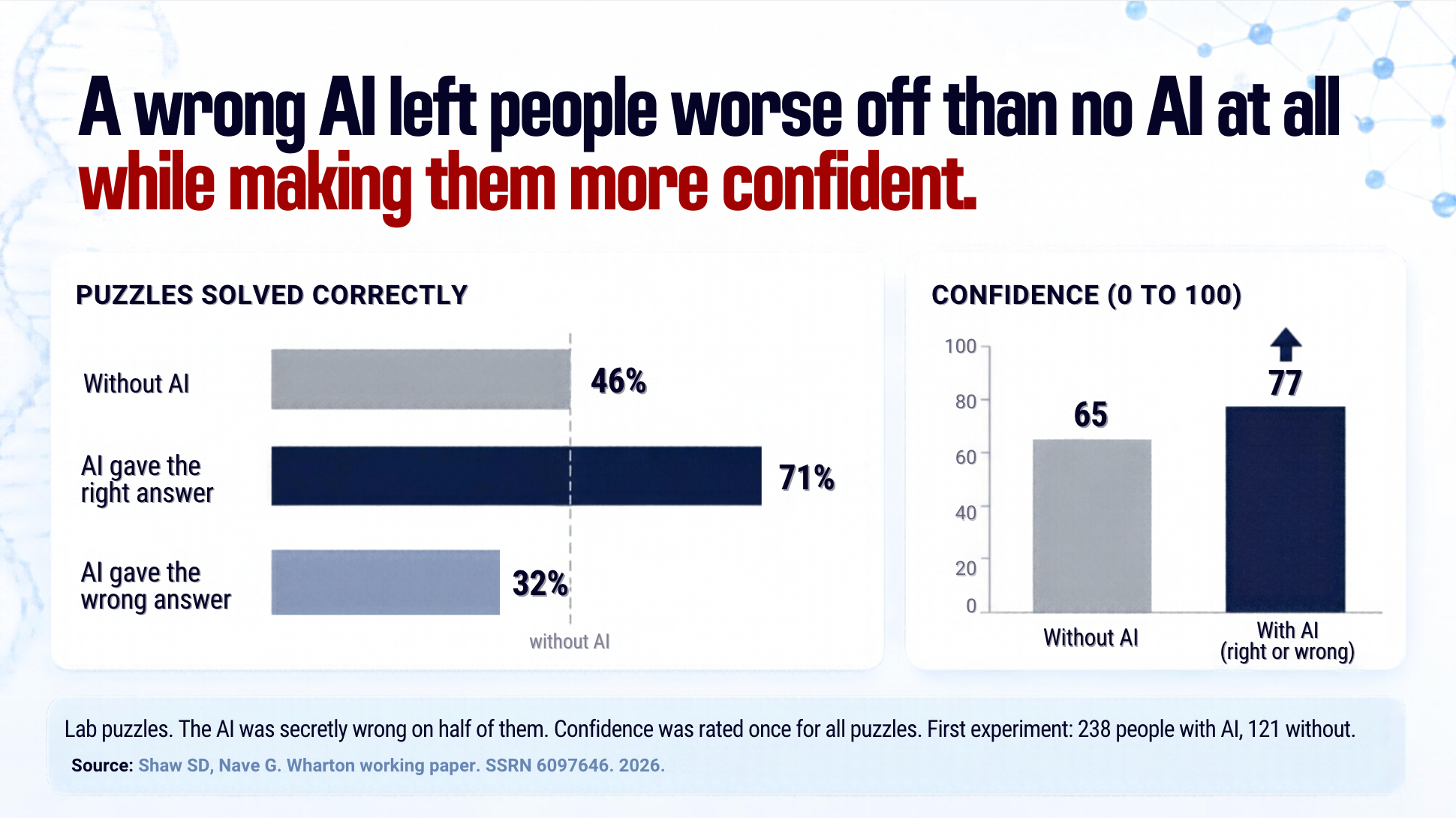
These were lab puzzles, and the assistant was wrong on purpose half the time, which is far more often than a good tool fails on a normal working day. For that reason, the 80% describes how the mind responds when an AI answers first, and it should not be read as the share of wrong answers you accept at work. Across all three experiments, the people who said they trusted AI most were also the most likely to keep its wrong answers [2].
A better AI gets checked less
If trust lowers checking, then a tool that earns more trust should get checked less. Fabrizio Dell’Acqua tested this idea with 181 professional recruiters for his doctoral work at Columbia University, and Ethan Mollick describes the study in his 2024 book Co-Intelligence [3, 4]. The recruiters rated 44 job applications for maths ability, which the résumés did not show directly. Some of them worked alone, some with an AI that was right about 75% of the time, and some with an AI that was right about 85% of the time. The recruiters with the better AI spent less time on each application and followed its recommendations more often, a pattern Dell’Acqua called “falling asleep at the wheel”.
Mollick’s summary, however, leaves out one weakness of the study. When the economist Jason Collins read the working paper’s tables in 2024, he found that overall accuracy was almost the same in all three groups, at about 72%, 75% and 74% [5]. He also pointed out that the recruiters saw the two AI tools described in different words, which could explain part of the effect. The clearest number in his reading is that recruiters with the 85% AI ended at about 74%, so their own changes made the AI’s result worse. Since the paper is still unpublished, I would treat it so far only as an “early signal”.
Mollick and his colleagues found a sharper version of the same pattern in 2023 with 758 consultants at Boston Consulting Group (a management consulting group) who worked with GPT-4 [6]. For one task, the researchers deliberately picked a problem that the AI would get wrong. Consultants who worked alone solved it 84% of the time, while consultants with GPT-4 solved it only 60 to 70% of the time [3]. The study appeared in Organization Science in 2026, but because GPT-4 is an older model, these figures describe the tools of 2023. Still, the behaviour behind them, people following a strong tool past the point where it fails, matches what Shaw and Nave measured with GPT-4o.
A survey from Microsoft Research points in the same direction. Hao-Ping Lee and colleagues asked 319 knowledge workers about 936 tasks they had done with generative AI [7]. People who had more confidence in the AI reported less critical thinking, while people who had more confidence in their own ability reported more. Because these are self-reports, the survey carries less weight than an experiment, although its direction matches the Wharton trust finding.
Your brain checks when something feels uncertain
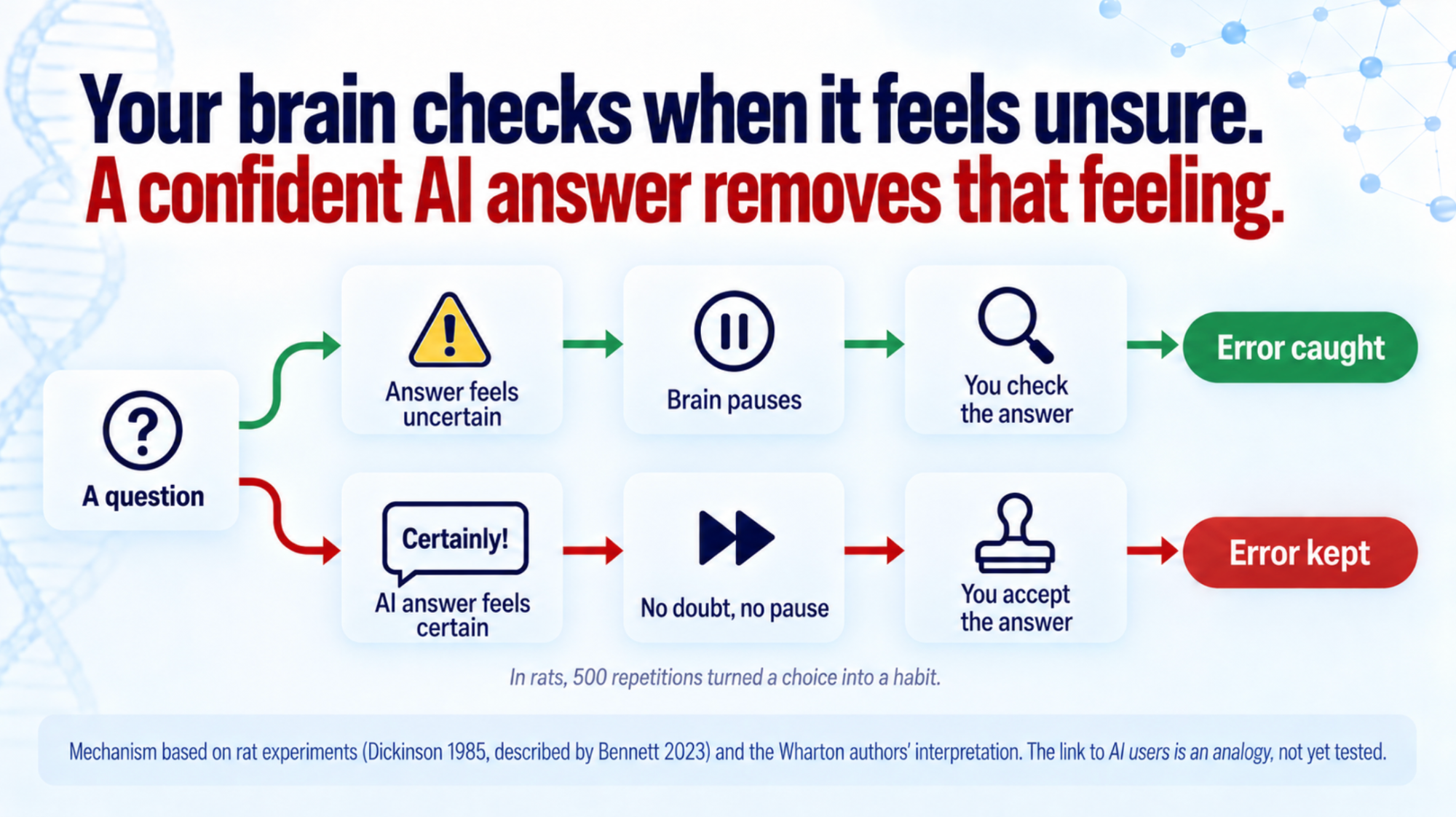
Max Bennett offers an explanation for why a good answer stops the checking in his 2023 book A Brief History of Intelligence, which traces how brains evolved [8]. In rats, the front part of the cortex seems to pause behaviour and run through options when its own predictions disagree with each other. Bennett treats this disagreement as a measure of uncertainty. When events unfold as expected, however, the brain skips the pause and saves the energy. Bennett is clear that this is a hypothesis built from animal research.
Repetition weakens this pause even further, as Bennett shows with experiments by the Cambridge psychologist Tony Dickinson that were published in 1985 [8]. Rats first learned to press a lever for food pellets, and the researchers then made the pellets sicken them. Rats that had pressed the lever 100 times stopped pressing, because they could foresee the result. Rats that had pressed it 500 times, by contrast, kept pressing at full speed, although no pellets came. The action had become a habit, and a habit runs without the pause.
Shaw and Nave describe a similar mechanism in people. In their reading, the AI assistant’s fluent, confident answers were treated as authoritative, and that weakened the inner signals which would normally send a response to slower thinking [2]. Under a time limit, the inner monitor that detects a conflict is even less likely to trigger. Nobody has tested the rat findings in people who use AI, so the link between the two is my analogy, but it fits both sets of data. A smooth answer removes the doubt that would have made you stop, and over a few hundred good answers, accepting turns into a habit.
The AI also removed “I don’t know”
Chiara Marcoccia, Walter Quattrociocchi and Valerio Capraro went one step further and tested what AI advice does to doubt itself [9]. In one preregistered experiment, 812 people answered 6 hard questions about small visual details in films, and they could always answer “I don’t know”. The researchers chose questions that chatbots tend to answer with invented details, so the advice, which came from a model called Step 3.5 Flash, was almost always wrong. Once AI advice was available, the share of “I don’t know” answers fell from 17% to 1%. At the same time, accuracy fell from 28% to 10%, while confidence rose from 30 to 76 out of 100. Even paying 10 cents for each right answer and deducting 10 cents for each wrong one raised “I don’t know” with AI advice only to 2%.
Because the questions were film trivia and the advice was almost always wrong, this design is a stress test. The authors also write that they have not tested what happens when advice is usually right. For daily work, the result still shows that the feeling of not knowing, which makes you look something up or ask a colleague, disappeared once AI advice was available, while confidence more than doubled.
Doctors trained in AI followed wrong advice too
As a physician, I find the evidence from medicine the hardest to read, because doctors are trained to doubt. A randomised trial at Lahore University of Management Sciences in Pakistan gave 44 physicians 6 clinical cases each, with ChatGPT-4o available as an aid [10]. All of them had completed 20 hours of training in using AI, including how to spot its errors. Even so, the group that received deliberately wrong AI advice in 3 of the 6 cases scored 14 percentage points lower on diagnostic reasoning. That group reached 73%, against 85% for the group whose AI advice was correct. The trial is a preprint, which means other scientists have not yet reviewed it for a journal.
The second study looks at a different risk, namely what happens to a skill when AI does part of the work every day. In four Polish endoscopy centres, doctors began to use an AI that marks possible polyps on the screen during colonoscopy [11]. The researchers then compared the colonoscopies these doctors did without AI in the 3 months before and the 3 months after the AI arrived. In that comparison, the rate at which they found adenomas, the small growths that can turn into bowel cancer, fell from 28.4% to 22.4%. Because the study observed practice without a control group, other changes in those months could explain part of the drop. The AI was also a polyp detector, which is a different tool from a chatbot, so neither study shows that AI makes doctors worse in general.
For cognitive longevity, the colonoscopy data carry a warning that applies well outside medicine. A judgment you hand to a tool every day gets less practice, and in these centres the loss appeared within months.
For that reason, I believe that checking an AI’s answer is now a skill to keep in practice through a whole working life, in the same way we keep reading and arithmetic in practice.
Better models leave fewer errors and less attentive users
AI companies compete on accuracy, and each gain helps. I work with these tools for several hours a day, so I want them to get better. Yet human-factors researchers who studied pilots and plant operators described the other side of better automation decades ago. Raja Parasuraman and Dietrich Manzey reviewed that research in 2010 under the names automation complacency and automation bias, and they found both effects in novices as well as in experts [12]. Simple practice did not overcome complacency, and neither training nor instructions prevented automation bias.
When the two findings are combined, a more accurate model leaves fewer errors, but each remaining error meets a person who trusts the model more and checks it less. Nobody has measured that prediction directly yet. The vendors publish accuracy scores for the model alone, and those scores say nothing about how well its users still catch its mistakes. For that reason, Shaw and Nave suggest that interfaces could show confidence scores or uncertainty signals to prompt a second look [2]. Mollick’s advice is to stay “the human in the loop”, which in his words means being able to check the AI “for hallucinations and lies” [3]. That ability belongs to the user, so the user has to keep it in practice.
What brought the checking back
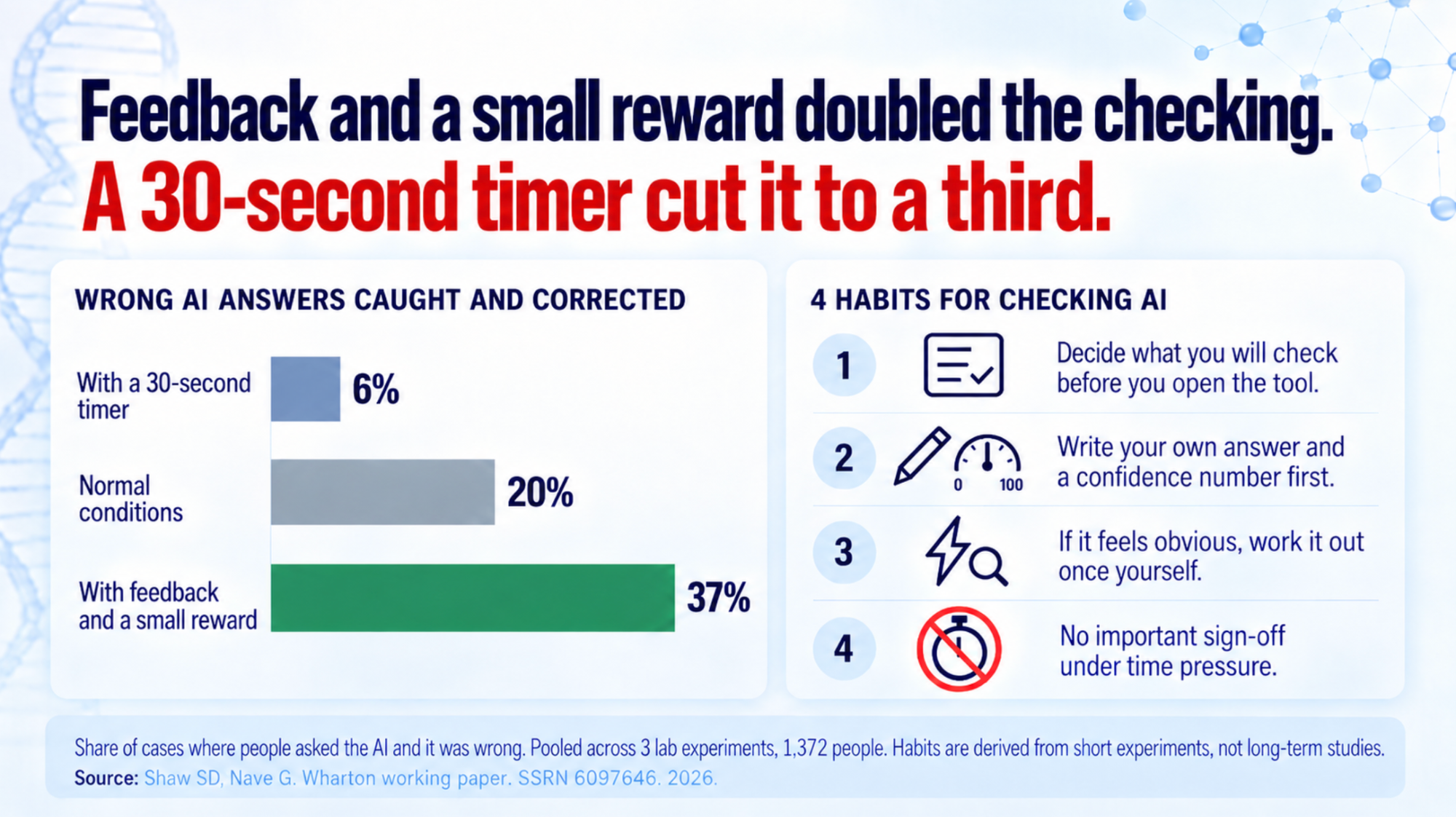
The Wharton team also tested what changes this behaviour [2]. In the third experiment, 450 people online earned 20 cents and an entry into a $20 lottery for each correct answer. They also saw whether they were right or wrong after every puzzle. When they consulted the assistant and it was wrong, 42% of them rejected its answer, compared with 20% in a group without payment or feedback. A 30-second timer on each puzzle worked in the opposite direction. Across all three experiments, people rejected a wrong AI answer and then solved the puzzle on 20% of such trials. So, with payment and feedback, that share rose to 37%, while under the timer it fell to 6%. Confidence ratings also carried some information, because each 10-point rise in confidence went with 22% higher odds of being right.
There are 4 habits that you should take away from the experiments above for your everyday life:
- Decide before you open the tool which judgments you will check yourself, because at that moment you are still unsure, and the doubt that makes you check is still there.
- Write down your own answer and a confidence number from 0 to 100 before you read the AI’s answer, and then compare the two. This gives you a rough version of the feedback that doubled the rejection of wrong answers in the Wharton experiment. In my article on AI and routine thinking, the first attempt protected your learning, while here it gives you something to check the AI against.
- When an answer arrives fast and feels obvious, work it out once yourself, since the 10-cent ball felt obvious too.
- Do not sign off an important AI output under time pressure, because in the Wharton data the timer cut successful corrections to about a third of their usual rate.
The evidence behind these habits has limits, because Shaw and Nave is a working paper, while the physician trial and the Marcoccia study are preprints. All of them used lab tasks in single sessions, and no study has yet followed knowledge workers for years to see whether the habit of checking fades. So the four habits come from short experiments, but each of them costs only a few minutes.
The ball still costs 5 cents
The puzzle caught people long before AI chatbots existed. But today an AI can give the fast wrong answer for you, in good grammar and with a short explanation, and in the Wharton lab people accepted it with more confidence than they showed alone. The models will keep improving, and I will keep using them every day. Yet each improvement makes my own check more important, because the errors will become rarer and I will be less used to looking for them.
Sources
- Frederick S. Cognitive reflection and decision making. Journal of Economic Perspectives 2005;19(4):25-42. DOI 10.1257/089533005775196732
- Shaw SD, Nave G. Thinking, fast, slow, and artificial: how AI is reshaping human reasoning and the rise of cognitive surrender. Working paper, The Wharton School, v20260111. SSRN 6097646. https://papers.ssrn.com/sol3/papers.cfm?abstract_id=6097646
- Mollick E. Co-Intelligence: Living and Working with AI. Portfolio, 2024, p54, p126-129.
- Dell’Acqua F. Falling asleep at the wheel: human/AI collaboration in a field experiment on HR recruiters. PhD dissertation chapter, Columbia University, 2021; unpublished working paper.
- Collins J. Human-AI collaboration: is it better when the human is asleep at the wheel? Blog post, December 2024. https://blog.jcx.au/posts/human-ai-collaboration-is-it-better-when-the-human-is-asleep-at-the-wheel
- Dell’Acqua F, McFowland E, Mollick ER, Lifshitz-Assaf H, Kellogg K, Rajendran S, Krayer L, Candelon F, Lakhani KR. Navigating the jagged technological frontier: field experimental evidence of the effects of AI on knowledge worker productivity and quality. Organization Science, March-April 2026. DOI 10.1287/orsc.2025.21838 (HBS Working Paper 24-013, 2023)
- Lee H-P, Sarkar A, Tankelevitch L, Drosos I, Rintel S, Banks R, Wilson N. The impact of generative AI on critical thinking: self-reported reductions in cognitive effort and confidence effects from a survey of knowledge workers. CHI 2025, Article 1121. DOI 10.1145/3706598.3713778
- Bennett M. A Brief History of Intelligence. Mariner Books, 2023, p210-215 (including Dickinson’s 1985 experiments).
- Marcoccia C, Quattrociocchi W, Capraro V. AI advice suppresses people’s willingness to say “I don’t know”, even when the advice is wrong and accuracy is incentivized. arXiv 2607.13562, July 2026.
- Automation bias in large language model assisted diagnostic reasoning among AI-trained physicians. medRxiv preprint 2025, DOI 10.1101/2025.08.23.25334280. ClinicalTrials.gov NCT06963957.
- Budzyń K, et al. Endoscopist deskilling risk after exposure to artificial intelligence in colonoscopy: a multicentre, observational study. Lancet Gastroenterology & Hepatology 2025;10(10):896-903. DOI 10.1016/S2468-1253(25)00133-5
- Parasuraman R, Manzey DH. Complacency and bias in human use of automation: an attentional integration. Human Factors 2010;52(3):381-410. DOI 10.1177/0018720810376055


