

Compare muscle from a 25-year-old with muscle from a 75-year-old and hundreds of molecular differences show up. But how many of those are actually aging, and how many are just fifty years of moving less, is a question that is often ignored in the public debate, and even the field itself has mostly waved at it.
A group in Amsterdam and Maastricht built a study that pulls the two apart, and Nature Aging published it on 3 July 2026.
They matched their young reference group against their normally active older group on daily steps, 10,183 versus 9,646, and on time spent in high-intensity activity, 2.5% versus 2.0%, so the comparison came down to two groups covering roughly the same ground each day but were fifty years apart. Interestingly, even then the molecular gap between them stayed wide, with 1,106 genes turned down, heavily loaded with cellular respiration and energy metabolism, and another 1,628 turned up. So it turns out: Walking as much as a 25-year-old does not stop your muscle from reading as old!
But the trained group did more than walk. This group was a group of 16 older adults who had kept up structured exercise at least 3 times a week, an hour at a time, without a break for over a year, and who were averaging 14,062 steps a day on top of that. And what was fascinating is that in their muscle, somewhere between 45-62% of those same age-related differences had gone missing.
So, ordinary daily movement leaves almost all of that molecular gap in place, while in the trained group close to half of it is gone.
What the study was built from
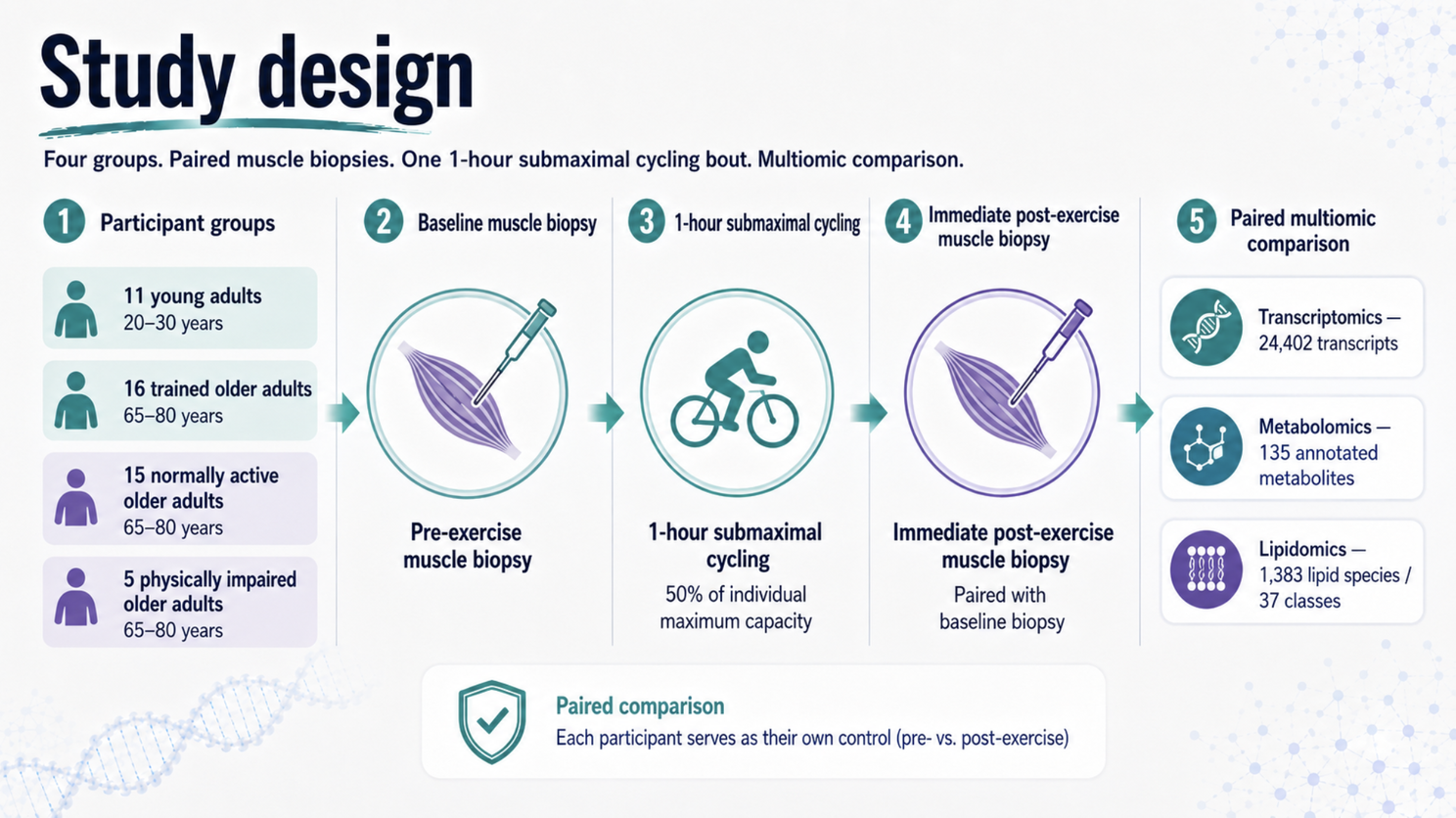
Georges Janssens and Riekelt Houtkooper at Amsterdam UMC ran the analysis on a cohort that Joris Hoeks and Patrick Schrauwen had built and phenotyped in Maastricht years earlier. Of the 47 participants, 11 were aged 20 to 30, and the other 36 were aged 65 to 80 and sorted by physical function into exercise-trained (16), normally active (15) and physically impaired (5).
Each label rests on a specific threshold. “Normally active” meant no more than one structured session a week. “Impaired” meant a Short Physical Performance Battery score of 9 or below, the clinical cutoff for meaningful mobility limitation. “Trained” meant those three hours a week were sustained for over a year. The paper describes this group as lifelong exercisers, though what it verified was a single unbroken year, and those are different populations.
Everyone then cycled for an hour at half their maximum capacity, fasted, with biopsies taken from the thigh before and immediately afterwards. Then each sample was read across 24,402 transcripts, 135 metabolites and 1,383 lipids spanning 37 classes. The trial was registered as NCT03666013, and Nature Aging files the paper as a “Resource”, a deliberately modest label.
Energy production is most of what training touched
In the trained older adults, 55.9% of the age-upregulated differences and 57.1% of the age-downregulated ones were absent, and sensitivity analyses put the range at 45-62% depending on where significance thresholds sit and whether the 5-person impaired group is counted.
The strongest signal in that responsive fraction sits in energy production, in the age-downregulated respiration genes. NDUFS1 and COX5A, two components of the mitochondrial respiratory chain, were turned down in normally active and physically impaired older adults, and that difference vanished in the trained group. The same gradient held across respiratory complexes I through V.
And NAD+ tracked it. NAD+ is nicotinamide adenine dinucleotide, a small molecule cells use to carry energy between reactions and which also feeds DNA repair and several stress-response enzymes, and its pathway metabolites sat among the top 10 age-altered compounds in this muscle. NAMPT, the rate-limiting enzyme in the NAD+ salvage pathway, was highest in young muscle, lowest in the impaired group, and strongly induced by the single hour of cycling.
What that does to the NAD+ story
Nobody in the human arm took nicotinamide riboside, NMN, or an NAD+ drip, and yet an hour on a bike raised the salvage enzyme that rebuilds NAD+.
Cells run a disposal system that tags and shreds proteins they no longer need, and in this muscle, the more those disposal genes were switched on, the less NAD+ was there. When the team blocked that system in cultured muscle and liver cells, NAD+ rose by roughly as much as dosing the same cells with NMN did, which points to the cell's disposal machinery setting NAD+ levels as much as the raw material supply does. How the two connect mechanistically is not yet worked out. That ran in cell lines with 4 replicates per condition, and nobody has tested any of it in a person.
Important to point out here is that every NAD+ product on the market runs on a refill model. The idea that the drain matters as much as the tap is newer and still mostly confined to the research literature, and this paper adds another piece of support to it.
The changes training did not reach have nothing in common
Roughly the other half of the differences in gene activity showed up in the trained group too. The authors call these unavoidable and keep the quotation marks around the word, which is fair for a study that never randomised anyone to anything.
Their recommendation follows from that, namely that drug development should aim at what exercise cannot fix. Then, in the same paragraph, they report that the leftover changes share no common biology. Some are genes for nerve-to-muscle signalling turning up, others are genes in the WNT pathway turning down, which is a system cells use to coordinate growth and repair, and the rest sit across unrelated processes with nothing obvious linking them.
That makes the remaining half a hard target for drug development. Pointing a molecule at a single broken pathway is a solvable problem, and what the authors found instead is a scatter of unrelated changes with no shared cause to attack. So, the pill that matches exercise and then goes further is further away than the pitches suggest, and for now training is the only lever here that broad human evidence actually backs.
Then they made everyone work
Every number so far comes from muscle sitting still, because those biopsies were taken before anyone got on the bike.
After an hour of cycling, muscle in all four groups switched on the same broad programme, turning up genes that drive inflammation and repair, among them IL6 and TNF, two of the signalling proteins the body uses to raise an alarm once tissue has been stressed. What differed was how closely each older group's reaction resembled the young reaction. On a scale where 1 would mean identical, the trained group came in at 0.45, the normally active at 0.39, and the physically impaired at 0.26. The order is consistent and the numbers are middling, so this is a gradient rather than trained older muscle behaving like young muscle.
The authors flag their own problem with this, and it cuts at their most quotable result. Everyone rode at half of their own maximum, which means the trained participants were pushing considerably more actual power for the same felt effort, so their bigger molecular reaction may partly be the bigger workload rather than better biology.
Even allowing for that, something appears under load that a resting sample does not show. How hard the muscle answers when you ask it to work, is itself a measure of fitness.
Why that should worry the people building longevity drugs
The authors state the consequences themselves. The older adults whose muscle reacted most strongly to the exercise were also the ones in the best physical shape, which raises the possibility that longevity drugs designed to damp inflammation down could take away something people need.
They name the case directly. IL-11 is a signalling protein involved in inflammation and tissue scarring, and blocking it extended both lifespan and healthy lifespan in mice in a 2024 Nature paper, which made it one of the most closely watched targets in the field. A correlation across 36 older adults does not refute that work and cannot. But what it does is put a specific and testable question to it, from a group that measured what happens when aging muscle is asked to do something hard.
Set against the question this piece opened with, the warning gets sharper. If part of what training buys you is a stronger reaction to stress, then a drug that quiets that reaction may take away the same thing deconditioning takes away, while the numbers on a resting blood test look unchanged or better.
The same blind spot runs through the consumer end of the field, where almost every biological age test reads the body at rest and returns a single number, whether it is built from a blood sample, a panel of proteins, or a DNA methylation pattern, which is a chemical tag on DNA that shifts in predictable ways as people get older. Two people can produce nearly identical resting numbers and cope completely differently with a real physical challenge, and how someone copes with that kind of challenge is a large part of what determines who walks out of hospital after a hip fracture. Nobody is going to run a cycling test with two muscle biopsies in a clinic, though the principle behind it could be borrowed.
What the 47 people, none of them randomised, cannot tell you
The older groups were not matched to each other. Trained participants averaged 68.0 years and a BMI of 23.6, normally active 70.7 and 26.0, physically impaired 72.2 and 27.4. The statistical models accounted for sex and for the before-and-after comparison, but not for those age differences between the older groups, so a few years and a real weight difference sit inside the trained-versus-normal comparison.
The design is what researchers call cross-sectional, meaning different people were compared once, rather than followed over time, and nobody was assigned to train. Older adults still walking 14,000 steps a day differ from their peers in genetics, illness, medication and joint health, and in whatever made regular exercise feel possible in the first place, so better muscle is plausibly a result of the training and a reason they were able to keep training.
Also, the muscle samples were analysed as a whole rather than cell by cell, and the trained group turned out to have more slow-twitch fibres, the endurance type. Some of what reads as younger gene activity may therefore reflect what their muscle is made of rather than how each cell is behaving.
The cohort itself is also not new, having been described in Nature Communications in 2021 by the same groups. Participants were Dutch and chosen deliberately from the extremes of fitness rather than to represent a population. The network diagrams linking individual genes to physical measurements were also not corrected for the fact that testing thousands of associations at once throws up some by chance, which makes those particular links leads rather than findings.
What are the main points here?
- Walking a normal amount does not spare your muscle. The young group and the normally active older group covered roughly the same ground each day, around 10,000 steps, and the molecular gap between them was still wide. Deconditioning in the everyday sense of moving less accounts for almost none of that gap.
- Structured training is a different thing entirely. In the people doing three hours a week, held without a break for over a year, somewhere between 45-62% of those age-related differences were simply absent.
- What training preserved was energy. The strongest part of that responsive half sits in the systems muscle uses to make and use energy, which is also where the NAD+ decline everyone sells supplements for shows up.
- Roughly half of the age-related changes in gene activity were still present in the trained group, without having uncovered a single cause behind them. Those leftover changes seem to share no common biology, which is hard to aim a drug at them.
- The fittest older adults were the ones whose muscle mounted the biggest inflammatory response to the hour of cycling, while the most impaired mounted the smallest. That cuts against a whole strand of longevity medicine built on suppressing inflammation, which is aimed at the chronic low-grade kind rather than this acute flare. The authors raise the worry themselves, that a drug quieting inflammatory signalling could blunt the same reaction that goes with being in good condition, and none of it would show on a resting blood test.
Reference
Janssens, G. E., Trętowicz, M. M., Grevendonk, L. et al. Delayed molecular aging, preservation of energy metabolism and enhanced exercise response in exercise-trained human muscle. Nature Aging 6, 1482–1500 (2026). https://doi.org/10.1038/s43587-026-01150-x
Cohort phenotyping: Grevendonk, L. et al. Nature Communications 12, 4773 (2021). IL-11: Widjaja, A. A. et al. Nature 632, 157–165 (2024).


