

Your body runs several aging clocks at once, and your blood may soon show which one is running fast
A biological age test almost always sells the same thing. One number that says you are younger or older than your birth certificate, delivered like a verdict. Three recent papers across the Nature journals suggest that number is close to the least useful thing your blood can tell you.
A more useful question can be found one layer down. Which of your systems is losing ground, which disease risk is climbing, and whether any of it is still early enough to change. Blood proteins, it turns out, may be starting to answer exactly that.
What the studies actually found
A proteomic aging clock estimates biological age from the thousands of proteins circulating in your blood. Proteins are the body's working molecules and its live status updates. They carry traffic from immune cells, blood vessels, organs and tissue under strain, and they shift with inflammation, repair and organ stress while a person still feels perfectly well. That last part is what makes them interesting, because most age-related disease runs silent for years. Atherosclerosis long predates the heart attack. Kidneys fail quietly. Tumors grow before they are found.
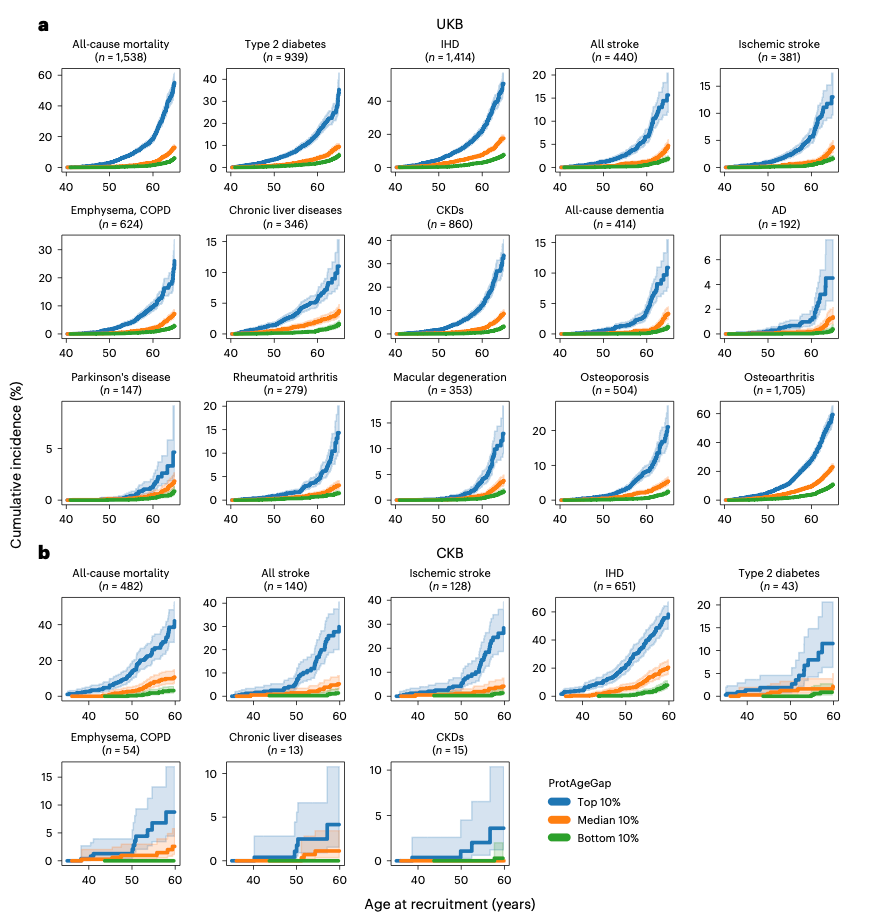
Two large studies now moved this from idea to evidence. In Nature Medicine, Argentieri and colleagues built a clock from 2,897 plasma proteins in 45,441 UK Biobank participants, distilled it to 204 proteins, and validated it in Chinese and Finnish cohorts. The accurate age prediction was the least of it. The same protein signature tracked frailty, slower reaction time, weaker cognition, and 18 major chronic diseases, with the steepest links to Alzheimer's, dementia and chronic kidney disease. People in the top 5% of protein age carried roughly 5.8 times the Alzheimer's risk of those in the bottom 5%.
In Nature Aging, Robinson and colleagues then tested similar clocks in 17,473 Europeans from the EPIC study, across 24 diseases, with follow-up reaching 28 years and mortality confirmed in a second cohort. Their combined score predicted death about as well as the classic lifestyle risk factors clinicians already lean on, and it added information on top of them. Each extra year of biological aging in the blood carried around a 13% higher risk of dying, which their life-table conversion turns into something close to six months of life for every year the proteins run ahead. The signal even held when the researchers discarded every death and diagnosis in the first 5 years, the test that separates a genuine early warning from a clock quietly reading disease already present.
The body does not age as one clock
What's the finding from these papers worth sharing? When the EPIC team split the score into organ-specific clocks, several lined up with the exact disease you would expect. Kidney age tracked kidney cancer. Lung age tracked lung cancer. Artery age tracked stroke. Heart age tracked coronary disease. In contrast to that, a single biological age flattens all of that into one average. But a panel of organ ages opens it back into a map.
The twist should change how we talk about dementia. Brain age, measured this way, did not predict neurodegenerative disease across roughly 20 years. The reading the authors offer is that in midlife, whole-body aging, the immune system, the vasculature, the kidneys, the slow burn of inflammation, forecasts later brain decline better than any brain-specific number. Dementia starts to look less like a disease that begins in the head and more like the visible end of a body-wide process.
What this round of studies cannot tell you yet
This is where the field earns trust or loses it, and where marketing gets ahead of the data. A Nature Aging review by Xiao and colleagues lays the problem out plainly: "These clocks differ by measurement platform, cohort, ancestry, age range, and whether they were trained on age or on death. Across the major clocks, only a handful of proteins are even shared, so two tests can both call themselves proteomic age clocks and measure partly different biology. Protein levels drift with an infection, a bad night, the time of day. And no proteomic clock has yet stood as an endpoint in a randomized trial, which means nobody has shown that lowering your score lowers your risk. These are associations read from observational data, not proof of cause."
The lifestyle numbers keep the same discipline. In EPIC, heavy smokers ran about 14 months biologically older than never-smokers, heavy drinkers about 7 months, the least active about 3 months. BMI and diet on their own showed no clear signal. These clocks read deep, slow biology, which makes them a poor scoreboard for this week's supplement stack.
So before trusting any test that offers you a biological age, the questions are worth asking out loud. What has it actually been validated to predict? How reproducibly does it measure the same person twice? What does it add beyond blood pressure, ApoB, Lp(a), glucose, kidney and liver markers, fitness and family history? Does the number moving mean the risk moved?
Where that leaves us
The age number was always the least interesting part. The real value is the early warning, the chance to catch one system quietly slipping while there is still room to act. The validation for that still has a long way to travel and the studies are candid about that. Nevertheless, I find it a hopeful place to stand, with the useful version of this technology coming into view: a test that points you at the one organ worth watching, years before it would otherwise speak up.
Based on:
Argentieri, M. A., Xiao, S., Bennett, D. et al. "Proteomic aging clock predicts mortality and risk of common age-related diseases in diverse populations." Nature Medicine 30, 2450–2460 (2024). https://doi.org/10.1038/s41591-024-03164-7
Robinson, O., Xiao, H., Homann, J. et al. "Associations of proteomic age clocks with lifestyle risk factors, incident chronic diseases and mortality in two European cohorts." Nature Aging (2026). https://doi.org/10.1038/s43587-026-01163-6
Xiao, H., Lau, C.-H. E., Dehghan, A. & Robinson, O. "Proteomic aging clocks in epidemiological studies: advances, applications and prospects." Nature Aging 6, 970–986 (2026). https://doi.org/10.1038/s43587-026-01118-x


