

Over the past few years, a new kind of number has entered the way we talk about health. You send off a few drops of blood or some saliva, and a few weeks later a report tells you that your calendar age is 52, but your body is aging like a 47-year-old's. The number feels personal in a way most lab results do not. It does not describe one organ or one risk. It seems to sum up the whole of you in a single figure, something you can screenshot and send to a friend. Many people now retest every few months to watch it change, and there are public leaderboards that rank who is aging most slowly. The number I'm writing about is your BIOLOGICAL AGE.
The idea is appealing, and the science behind it is real. But the term "biological age" hides a problem, and a paper with the title “An open competition for biomarkers of aging” published this month by Ying et al. in the scientific journal Nature Aging brings it into focus. The publication, set out to answer a different question, and almost in passing it shows why a single biological-age number can mislead you.
For more than a decade, the tools that estimate biological age have multiplied. Each lab tends to build its own, train it on its own group of people, prepare the data in its own way, and judge its accuracy by its own standard. So the field is full of confident numbers that have rarely been tested against each other on equal terms. Think of 100 thermometers, each calibrated in a different kitchen, each claiming to be the accurate one. You cannot know which to trust until you put them all in the same pot of water at the same time and read them side by side.
The Biomarkers of Aging Challenge did roughly that. A consortium of aging researchers took one hidden dataset, the molecular profiles of 500 people aged 18 to 99 from a Boston hospital biobank, and invited the world to compete at reading it. In total, 152 teams from 28 countries took part. The format came from another part of biology, where it had already proven useful. In protein research there is a contest called CASP, short for Critical Assessment of Structure Prediction. For years it gave competing teams the same unsolved proteins, asked them to predict the 3D shape each one folds into, and then scored every team against the real answer. That open, repeated competition is widely credited with driving the breakthrough behind AlphaFold, the software that now predicts protein shapes with high accuracy. Aging research had never run a contest like this. This was its first.
Two rounds made up the competition, and the difference between them is the heart of the story.
The result that tells you little
In the first round, teams predicted a person's chronological age, the ordinary calendar age, from DNA methylation. Our DNA carries the genes we inherit, and on top of them sits a layer of chemical tags that help switch genes on or off. Some of these tags change in a steady, predictable way as we age. In 2013, the geneticist Steve Horvath used them to build a "clock" that estimated age to within a few years. The 2024 teams went further. Their best models cut the average error, the typical gap between the predicted age and the real age, known as the mean absolute error, to under 2.5 years. Horvath's clock was off by about 5 years on this dataset. On the surface, the field had nearly doubled its accuracy in a decade.
That number will be quoted everywhere. It might deserve less weight than it will get, and the reason is built into what a biological-age test is for.
The value of such a test comes from disagreement. You already know your calendar age; it is on your passport and needs no lab. What you want from a clock is the part it can add: a signal that your body is older or younger than your years. That signal lives in the gap between the clock's estimate and your real age. A 60-year-old whose biology looks like 50 is interesting only because the two numbers differ. The difference is the information.
Now consider what happens when you train a clock to match the calendar more and more exactly. You are teaching it to shrink that gap. As the gap shrinks, the signal you were paying for shrinks with it. A clock that guessed chronological age perfectly would tell you nothing you did not already know. So the headline achievement, predicting age to within 2.5 years, is the field getting very good at a task whose success removes its usefulness.
There is a second reason to treat the headline carefully. The new models could practice against this exact dataset through a live scoreboard, adjusting daily toward the right answers. The older clocks were run on a newer measurement technology they were not designed for, with no chance to adapt. Some of their lower score reflects genuine limits; some of it reflects an unequal starting line.
When the question became survival
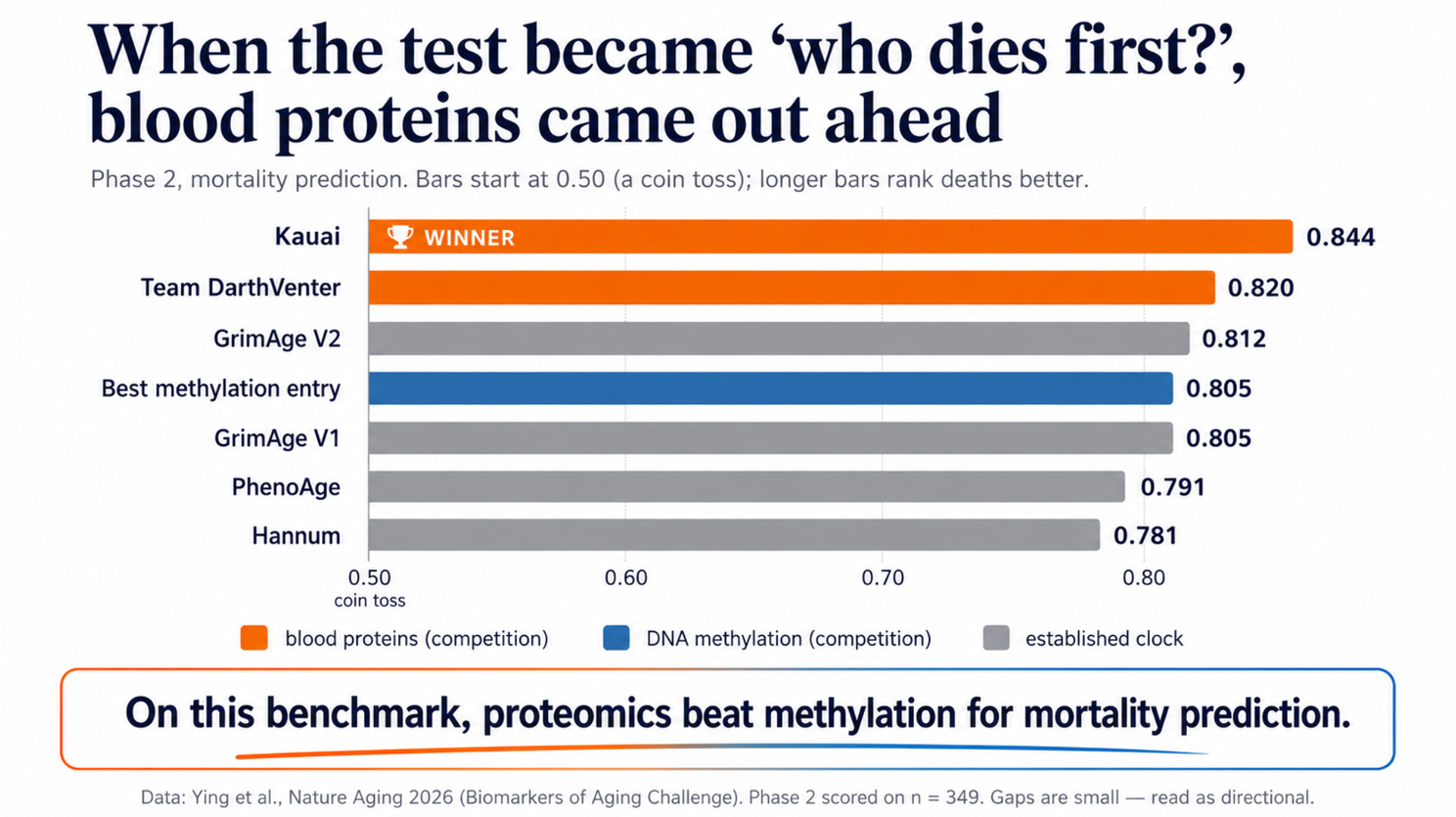
The second round changed the target. Instead of guessing age, teams had to predict who would die first, using survival records. Mortality is the real test for an aging biomarker, a biomarker being a measurable signal that stands in for something we care about but cannot see directly. Aging research ultimately aims to delay death, so the ability to predict it is what counts.
Far fewer teams could do it. The age round drew dozens; the mortality round drew 6, scored against the records of 349 people whose later survival was known. The winning team made a notable choice. It dropped DNA methylation and used blood proteins instead, the proteome, meaning the full set of proteins circulating in the blood, which reflect what the body is doing at a given moment. The team, named Kauai, trained its model on the blood proteins of nearly 52,000 people in the UK Biobank, a large British health study. It used a standard survival method called a Cox proportional-hazards model, which estimates how the risk of death rises or falls with a person's measurements. The model ranked who would die sooner with a concordance of 0.844. Concordance measures how well a model orders risk, where 0.5 is a coin toss and 1.0 is perfect. The best-known methylation clocks, including GrimAge, which was built specifically to predict mortality, scored lower.
The proteins the model relied on make biological sense. The strongest signals included neurofilament light chain (NEFL), which leaks into the blood when nerve cells are damaged; growth differentiation factor 15 (GDF15), which rises with metabolic stress and inflammation; and cystatin C (CST3), a long-used marker of kidney function. These point to specific systems. A doctor can see whether a person's risk comes mainly from the brain, from inflammation, or from the kidneys, which a single age score cannot show. Methylation can suggest that the body has aged. Proteins start to show where the strain is.
A few limits are worth stating clearly. The mortality round was small. A lead of 0.03 across 349 people points to an advantage for proteins here, but it does not settle the matter. The report is a short correspondence summarizing a competition, not a full research paper, so the detailed methods sit in open online archives. And the organizers have commercial interests: several hold patents on measuring cellular aging, and the sponsors include foundations active in the longevity market. The blind, automated scoring lowers the chance that this shaped the result. It does not remove it.
How to read your own score
If you already have a biological-age score, it can still be useful, as long as you read it correctly. Treat it as a model's estimate, shaped by what the model was trained to predict, rather than as a fixed fact about your body. Four checks tell you how much weight it deserves:
- What was it trained to predict? Your age, which you already know, or a hard outcome like disease or death, which you do not.
- Was it validated in people who were not part of building it? A model tested only on its own training data is grading its own homework.
- Does it add anything beyond standard measures such as blood pressure, cholesterol, kidney function, grip strength, and fitness?
- If your score drops after a new routine, is there evidence that the drop predicts a longer, healthier life, or has one of the markers the clock watches simply moved?
A score that falls after a month of fasting is a real biological change. Whether it means more years is a separate matter, and usually an open one.
So what?! (...is the takeaway)
A biological-age number is only as good as the outcome it was trained to predict, and only as trustworthy as the testing it has survived in people who were not used to build it. Accuracy against the calendar says little about health. The benchmark that matters is whether a biological clock predicts disease and death, and on that benchmark the proteins did better here than the established methylation clocks.
The body is not one system. Arteries, brain, immune system, and kidneys all age at different speeds, and no single number can stand for all of them. The field is moving toward a combination of signals: methylation for the slow, underlying state of the genome; proteins for current strain on organs; and ordinary blood work, imaging, and fitness tests for what is already visible. The main contribution of this competition is the method itself, a shared benchmark with hidden outcomes and fair comparison, which is what the field has lacked.
For anyone using these tests today, the practical rule is short. Treat one score as a starting point and look for agreement across several measures. Give more weight to tools that predict real outcomes and have been validated in independent people. A single number is only a clue, not an answer.
Source: Ying K, Paulson S, Reinhard J, et al. An open competition for biomarkers of aging. Nature Aging. 2026;6:1193–1195. doi:10.1038/s43587-026-01139-6. On proteomic prediction of mortality: Argentieri MA, et al. Proteomic aging clock predicts mortality and risk of common age-related diseases. Nature Medicine. 2024;30:2450–2460.


