

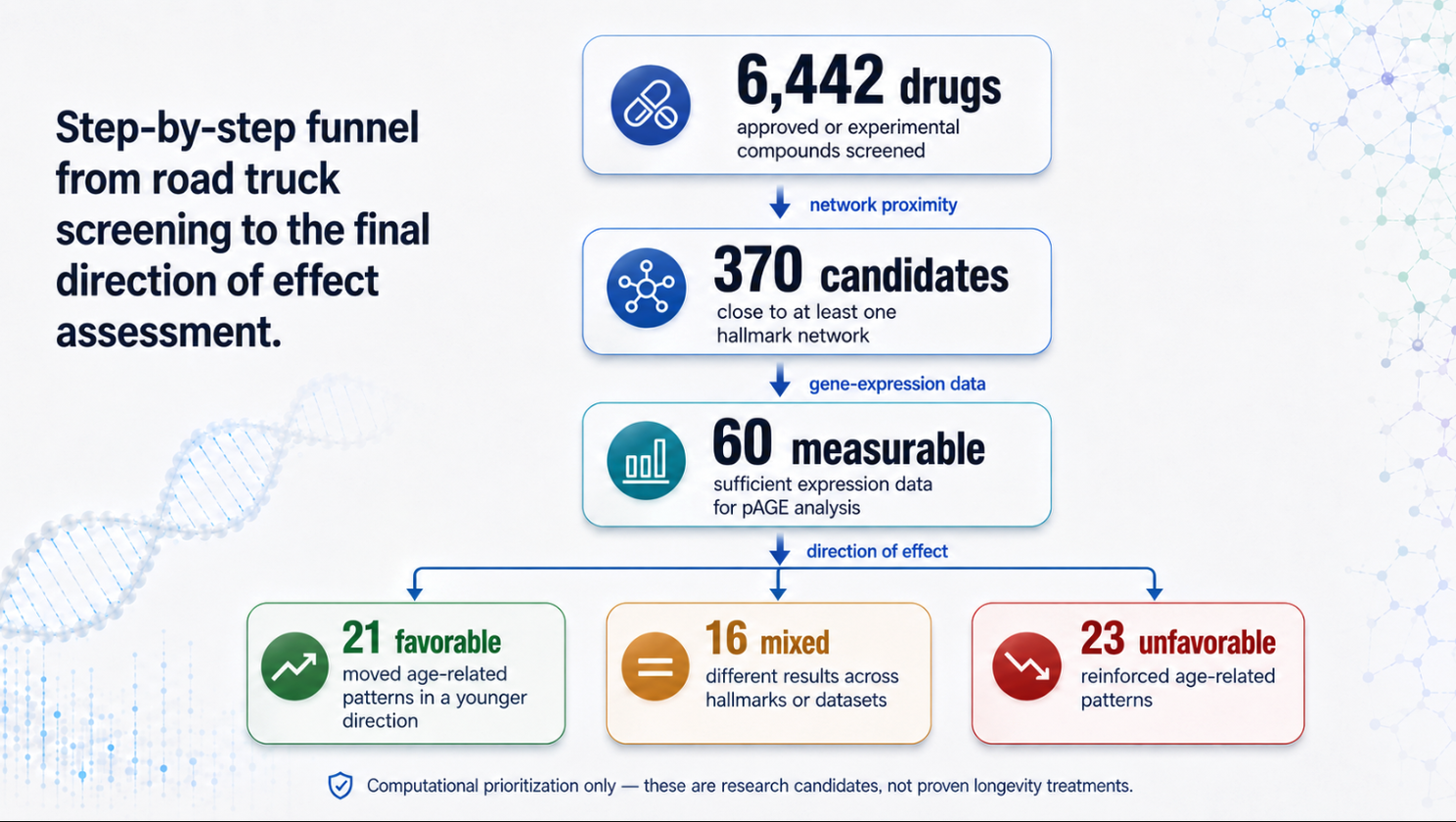
A new Nature Aging study screened 6,442 approved and experimental drugs against the molecular networks of aging. It found 21 that may push the body toward a younger state, and 23 that may push it the other way.
Somewhere in an ordinary pharmacy, approved years ago for diabetes or high blood pressure or inflammation, there may already be a compound that shifts the biology of aging. A study published in Nature Aging in June 2026 went looking for it. What the team produced is quite useful. They built a map that answers a question many longevity claims skip. It answers not only whether a drug can influence an aging process, but which way it pushes that process once it works.
But it gets even more interesting. The researchers screened 6,442 approved and experimental compounds. 60 of them had enough data to evaluate fully. Of those, 21 appeared to move gene activity toward a younger pattern, and 23 appeared to move it toward an older one.
So what separates the 21 from the 23? Direction. Both sets of drugs target equally the biology of aging, and yet they pull it opposite ways, one group toward a younger state and the other toward an older one.
That should change how you read a lot of what gets sold as longevity science. Scroll through any longevity feed and the same words keep coming up. A supplement "targets mTOR." A compound "activates AMPK." A protocol "supports mitochondria" or "clears senescent cells." Each phrase answers one narrow question, whether a molecule gets close to a pathway involved in aging. But none of them answer the question that actually settles things, which is where the push is heading once the drug arrives. On the evidence in this paper, that second question seems to carry more weight.
Aging research has more data than it has treatments
Over the past decade, genetic studies and animal work have tied thousands of genes to lifespan and age-related disease. But turning that knowledge into treatments has stayed slow. Part of the reason might be how the field organizes the biology.
Most of us picture aging through the hallmarks of aging, the recognized failure patterns of an aging body. The commonly cited 2023 hallmark framework counts 12 of them. This study works now with a slightly different set of 11, taken from the aging-gene database it is built on, among them genomic instability (accumulating damage to DNA), mitochondrial dysfunction (the cell's energy plants running poorly), and cellular senescence (cells that stop dividing but refuse to die). However you count them, the hallmarks are a useful way to cut a huge problem into parts.
But they mislead us when we treat those parts as separate boxes. A protein that drives inflammation may also shape insulin signaling. A gene that manages damaged cells may also touch DNA repair and cancer risk. A drug aimed at a single target sends ripples through many connected proteins before it ever reaches the process you meant to change.
The team tested whether the boxes hold. They started with the OpenGenes database and its 2,358 aging-associated genes, placed 1,250 of them onto the human interactome (a wiring diagram of 18,223 proteins joined by 524,156 physical interactions), and asked where they would land.
And they did not land at random. Genes belonging to the same hallmark clustered into the same network neighborhood, forming what the authors call a “hallmark module”. 9 of the 11 hallmarks formed statistically solid clusters. More telling, those clusters sat beside each other and overlapped, merging into one larger connected region the authors name the longevity module.
That overlap is the part that is important here. It means aging behaves less like eleven separate problems and more like one connected system, where a drug that pushes on one part pushes on the rest.
So a single clean drug for a single hallmark is probably the wrong thing to chase. Any compound powerful enough to move aging will reach several hallmarks at once, helping with some and doing harm to others.
How the researchers filtered 6,442 drugs?
The authors built a pipeline they call SHARP, short for systematic hallmark-based aging repurposing pipeline. It combines two measurements that answer two different questions.
The first filter is “reach”. Using a measure called network proximity, they asked how close each drug's known targets sit to each hallmark module. A drug can score well here even when it never touches a known aging gene directly, as long as its targets sit close enough to influence the neighborhood. This is how the pipeline surfaced 83 network drugs, compounds that would stay invisible to any method that looks only at direct target matches.
The second filter is “direction”, and it is the part the field has not been using much. The team built a gene-expression score they call pAGE. It compares how a gene's activity shifts with age against how the same gene responds to a drug. When a drug opposes the age-related shift, the score reads positive. When it reinforces the shift, the score reads negative.
A plain example. Say the activity of an inflammation gene tends to rise with age. A drug that lowers that activity works against the aging pattern. A drug that raises it further works in the same direction as aging. Repeat that comparison across many genes in a hallmark, and you get a read on whether a compound is likely pulling toward youth or toward age.
One caveat the authors point out, and so do I. A positive score does not mean a cell became younger. It means a drug moves a gene-expression pattern opposite to the one associated with age. That is a signal worth following up on but not proof of rejuvenation.
Why "it targets an aging pathway" is a weak claim
One of the sharpest lessons in the paper comes from cellular senescence.
A senescent cell is one that has stopped dividing after damage or stress. In the short term this guards against cancer. With age, these cells accumulate and leak inflammatory signals that harm the tissue around them. Clearing or calming them is a major longevity target, and "senolytic" has already become a marketing word.
The network screen correctly flagged two compounds, pimasertib and selisistat, as sitting close to the senescence module. Both genuinely influence senescence biology. Both push it the wrong way, promoting senescence rather than reducing it. A method that measured only proximity would still list them as relevant. The direction score is what separates relevance from likely benefit.
Which brings us back to the feed. "Targets mTOR", "activates AMPK", "supports senescent cells." Each phrase describes proximity and leaves out the questions that decide whether the effect helps or harms. In which tissue. At what dose. At what age. For how long. Through which downstream route. And what happens to the other systems wired into the same neighbourhood.
One nasal spray, turned into a testable hypothesis
The downstream route, though, is one question this method can actually answer. The paper's worked example, to show the method in action, is oxymetazoline, the active ingredient in common nasal decongestants and in treatments for eye redness and rosacea.
Oxymetazoline acts on adrenergic and serotonin receptors. Some of those targets sit near the module for altered intercellular communication, the hallmark that covers how cells signal to one another, including inflammatory and hormonal signaling. When the team traced the drug's likely path through the network, the signal did not take the obvious short route. It detoured through a protein called ACKR3 and into central aging-linked proteins, among them NF-kB, TP53, and AKT1.
In the expression data, oxymetazoline opposed age-associated changes in genes tied to sterile inflammation and cell-to-cell signaling. Its direction score for that hallmark came out positive, at 0.46. The model also linked the effect to familiar names in aging biology, including FOXO3, SIRT1, and the insulin, AMPK, and mTOR pathways.
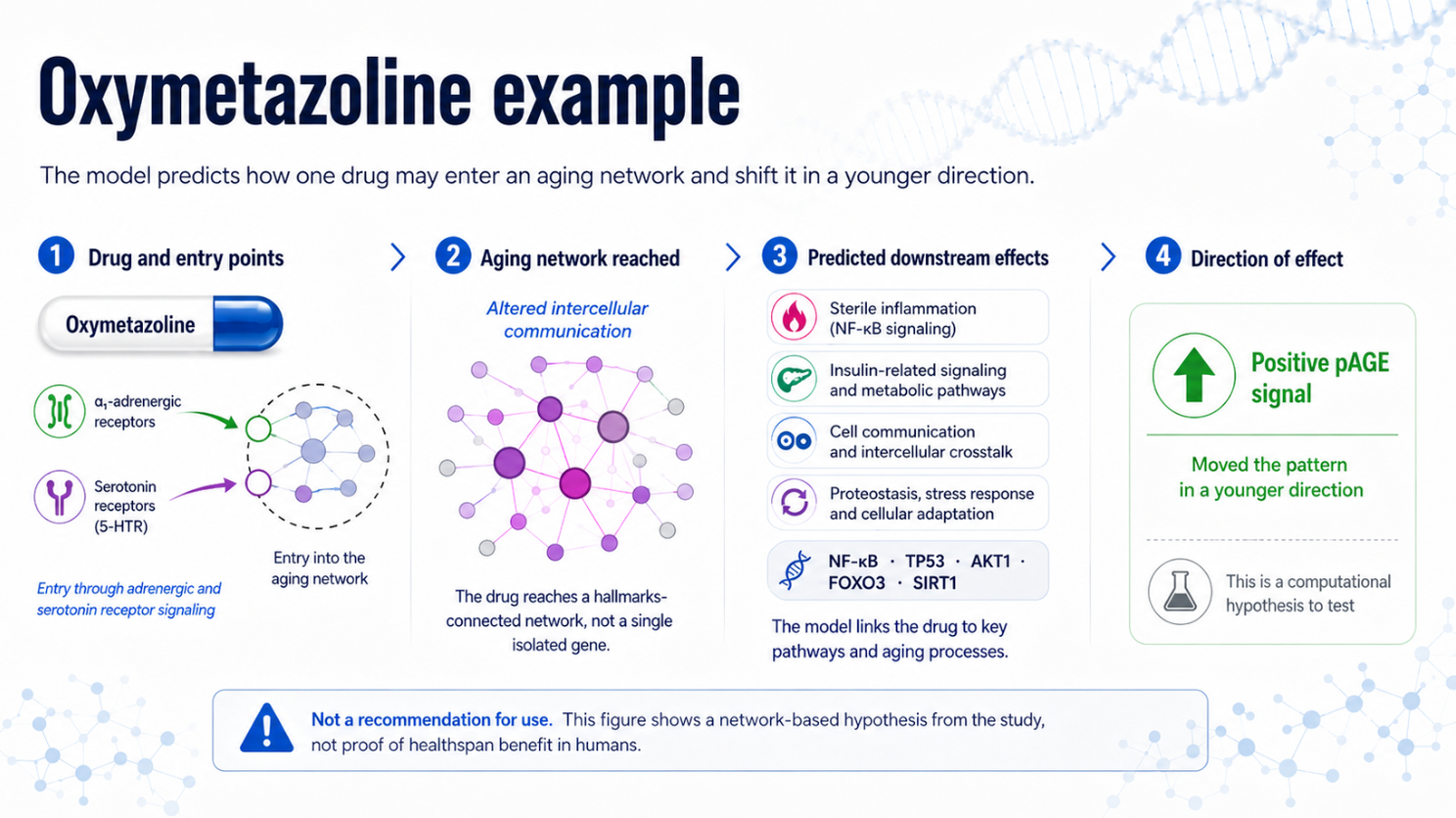
The nasal spray itself is almost incidental. The real result is that a common, unglamorous drug produced a specific, traceable, and testable prediction. Researchers can now expose cells or animals to it, measure the exact proteins the model named, and watch whether the biology moves the way the map says. A vague "might affect aging" became a claim you can try to break.
To be clear, none of this means or is evidence that nasal spray slows aging, and it is not a reason for anyone to start using one.
Does the method actually work? Better at finding winners vs. ruling out failures!
A screen is only as good as its track record, so the authors put it to the test against drugs whose outcomes are already known, some that extend lifespan and some that do not.
Against 11 drugs shown to extend lifespan in mice by the National Institute on Aging's testing program (ITP), the pipeline caught every one it could evaluate. 8 had usable data, and all 8 scored positive, giving 100% sensitivity. On 8 drugs, that headline number carries a confidence interval running from 63% to 100%. Against 17 compounds already in human longevity trials, including metformin and rapamycin, it caught 8 of the 9 it could evaluate. Against a separate set of mouse compounds tested only after the predictions were locked in, it caught all 5 that worked.
One honest remark, which the authors raise themselves. The mouse-lifespan drugs overlap with the very knowledge the model was built from, so the researchers restricted this test to their highest-confidence genes to limit the circular reasoning. Worth remembering when you read "100%."
Those numbers only go so far. High sensitivity means the method rarely misses a real winner. It does not mean the method can tell winners from losers. Among 17 drugs that failed to extend mouse lifespan, 7 had enough data to check, and 3 of those 7 were still flagged as candidates. A false-positive rate near 43%, on a tiny sample, with a confidence interval stretching from 10% to 82%.
So the method pulls promising candidates out of a huge pile, but it cannot yet throw the failures back. The validation sets are still too small to claim more.
Why the approach is still a step forward
Even with those limits, the approach earns attention, for several reasons that build on each other.
- It shrinks an impossible search. Testing thousands of drugs across aging outcomes in animals would be slow, costly, and ethically fraught. A network screen narrows the field before the lab work starts.
- It offers a mechanism, not only a ranking. Most computational screens hand back a score with no story attached. This one traces a route, from a drug target, through named proteins, into a hallmark and the genes whose activity shifts. That route is what makes a prediction testable.
- It finds the indirect candidates. Those 83 network drugs are relevant because biology rarely stops at the first protein a drug touches. Effects travel. Mapping the travel reveals compounds that a direct-match method would never see.
- It points toward combinations. Aging is multifactorial, and no single drug is likely to reverse every hallmark. Because the pipeline can score a compound across many hallmarks at once, it offers a rational way to design combinations for complementary coverage. That work would still have to account for drug interactions, overlapping toxicity, timing, and dose. Stacking several uncertain drugs does not create certainty. It can multiply risk.
- And it connects diagnosis to action, which is where this links to something you may already be tracking.
From age scores to intervention maps
The first wave of consumer longevity sold measurement. Biological age tests promised to squeeze a complicated process into one number.
A single score is a thin thing to act on. It tells you whether your biology looks older or younger than your actual age, and almost nothing about which system is slipping, what is driving it, or what would change it.
A more useful approach could work in three steps. It would find which organ, cell type, or process is actually drifting, map that drift onto a specific network of proteins, then test an intervention that can reach that network and move it somewhere safer.
This paper works on that third step, though at the level of databases and whole populations and not patients in a clinic, yet. But the authors see a future where these network signatures get combined with a person's genetics, lifestyle, and tissue data to fit an intervention to eventually their particular aging. They call that “precision geroscience”.
What that could mean is, that you have to work out which system is failing and which of its changes are truly doing harm, then find something that reaches it and nudges it back toward a younger state without dragging a healthy one the wrong way.
Aging is not one long list of things breaking down. Some of what shifts with age is the body pushing back against the damage, and forcing all of it toward a young pattern can strip away protection the body raised on purpose. A drug that makes an old pattern look young across the board might read as rejuvenation and still leave the person worse off. The aim is narrower, undoing the harm while leaving those defenses standing.
That is far more work than looking for a single pill that works for everyone, and it is closer to how medicine actually works, matching the treatment to the person and weighing every gain against what it might cost elsewhere.
The first treatment that genuinely slows aging might be a brand-new molecule, or a familiar drug repurposed for the job. More likely, it will be a combination of medicines we already have, matched to the networks that are failing and checked against the ones that are still fine.
Source: Gross B, Ehlert J, Gladyshev VN, Loscalzo J, Barabási AL. "Network-driven discovery of repurposable drugs targeting hallmarks of aging." Nature Aging, 26 June 2026. https://doi.org/10.1038/s43587-026-01161-8
Medical note: This article discusses a computational research framework. It does not offer medical advice or support self-experimentation with prescription or over-the-counter drugs.


