

If you follow longevity science, you've probably heard this many times:
Exercise is the closest thing we have to a proven longevity drug.
That statement is backed by decades of evidence. Regular physical activity lowers the risk of cardiovascular disease, type 2 diabetes, dementia, several cancers, frailty, and premature death. Everyone in the field or close to the field knows that, I know that. That's why I was fairly surprised, when encountering following question:
If exercise is one of the most effective longevity interventions we know, why don't all biological age tests show the same benefit?
A new systematic review and meta-analysis published in The Lancet Healthy Longevity looked at exactly that question. The researchers analyzed 44 studies involving more than 145,000 participants to examine how physical activity relates to biological age measured by DNA methylation, also known as epigenetic clocks. And their findings were far more interesting than the title suggests.
Exercise leaves a signal. But not every clock detects it.
Across the studies, people who were more physically active generally showed signs of slower biological aging. But when the researchers pooled the data, the picture became more nuanced.
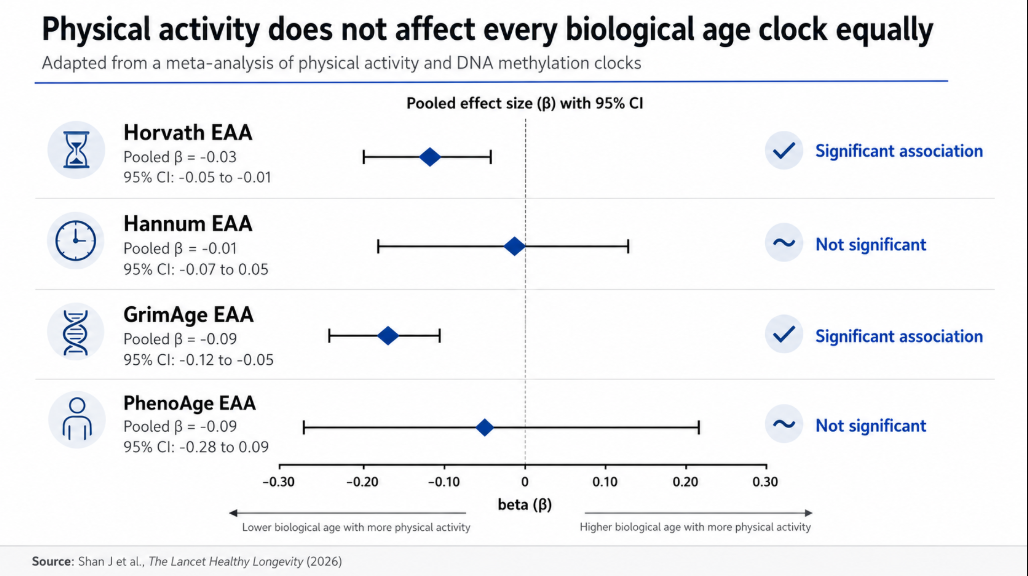
Higher physical activity was consistently associated with lower biological age measured by the Horvath clock and the GrimAge clock.
However, Hannum and PhenoAge DID NOT show statistically significant associations in the meta-analysis.
At first sight, that may sound like a technical detail but I think it's one of the most important messages in the paper. Because it tells us something fundamental again.
There isn't one biological age.
There are multiple ways to measure aging, and they don't all capture the same biology.
Different clocks are asking different questions.
We often talk about biological age as if it were a single number but that is becoming increasingly difficult to defend. Different epigenetic clocks were designed for different purposes. Whereas the first-generation Horvath clock was built to estimate chronological age from DNA methylation patterns, GrimAge goes a step further. It incorporates methylation signatures linked to inflammation, smoking exposure, plasma proteins, and mortality risk. That may explain why it appears more sensitive to the biological effects of exercise.
Other clocks emphasize different biological pathways and may respond less strongly to physical activity. In other words,
the clocks aren't necessarily disagreeing because one is wrong. They may simply be measuring different aspects of aging.
And this is a subtle but important distinction.
This is exactly where the field is heading.
A few weeks ago I wrote that the next generation of biological age tests will likely move beyond a single "biological age" score. Instead, we'll increasingly measure how different organ systems are aging. For example, your cardiovascular system, your immune system, your brain, your kidneys, your metabolism. Each may follow its own aging trajectory.
Interestingly, the authors of this Lancet review reach a similar conclusion.
They argue that future studies should increasingly use third- and fourth-generation biological age clocks, including system-specific biomarkers that can identify which biological systems respond to interventions such as exercise.
I think once we reach that point, biological age testing will become genuinely more useful for precision medicine.
But I think the biggest story isn't exercise.
The big story in the longevity field will be "measurement".
Think about how medicine has advanced over the past century. Cardiology accelerated once we could record the heart with the ECG. Diabetes changed once blood glucose became easy to measure. Critical care advanced with continuous monitoring of oxygen saturation, blood pressure, and other physiological signals.
Each of these breakthroughs gave medicine something new.
An objective way to measure disease, track progression, and evaluate treatments.
Longevity might now entering that same phase.
But are we there yet? Are we actually already able to measure biological aging rather than simply counting birthdays (as touted and claimed by many commercial longevity players)?
This Lancet review suggests we're still early.
If the most consistently validated longevity intervention we have, regular physical activity, does not produce a consistent signal across today's biological age clocks, perhaps the limitation is no longer the intervention. Perhaps it's the measurement.
To be precise here. That doesn't mean today's clocks are wrong. It means they're probably measuring different aspects of aging, and we still don't know which measurements matter most for predicting future health, disease risk, and response to treatment.
That makes biomarker science one of the most important frontiers in longevity.
Much of the discussion in longevity focuses on interventions. Rapamycin, GLP-1 drugs, Senolytics, Cellular reprogramming, Exercise, Nutrition. All of those are important and have their place. But none of them can be rigorously compared, optimized, or personalized without reliable biomarkers.
For decades, longevity research has focused on finding interventions that slow aging. now the field needs to do some catching up on reliably answering "how we know whether an intervention actually changed biological aging?", and putting biomarkers more at the center of the field.
The work of the Biomarkers of Aging Consortium, together with researchers such as Morgan Levine , Steve Horvath , Andrea B. Maier , and many others, is helping answer exactly that question and identifying which biomarkers actually predict health, disease, and response to interventions.
This Lancet paper reinforces why that distinction matters. If different biological age clocks respond differently to one of the most consistently validated longevity interventions we have, the next challenge isn't simply building more clocks.
It's building clocks we can trust for clinical decisions.
Primary paper
Shan J, Tay JH, Wang W, Tan R, Joshi R, Maier AB, Feng L.Physical activity and biological age measured by DNA methylation clocks: a systematic review and meta-analysis. The Lancet Healthy Longevity. 2026;7:100835.DOI: https://doi.org/10.1016/j.lanhl.2026.100835
Further reading
Biomarkers of Aging Consortium A global collaboration of researchers developing standards and validation frameworks for biomarkers of aging, with the goal of making them reliable enough for clinical trials and eventually routine clinical practice. Their work includes consensus roadmaps, open-source biomarker validation tools (Biolearn), and initiatives to establish clinically meaningful biomarkers for longevity interventions. Biomarkers of Aging Consortium


